Integrating Assets and People: A Smarter Approach to Asset Management for the Energy Sector
Learn how to optimize asset management for the energy sector to improve asset performance, asset reliability, and operational efficiency.
9 min read

An ERP for utility field service management connects dispatch, work orders, field technicians, inventory, asset management, customer billing, and finance within a single system. By connecting field and back-office operations, utilities gain real-time visibility into field activities, improve service delivery, and make better operational decisions across the organization.
Utility field operations are becoming more complex as infrastructure investments continue to grow. The Edison Electric Institute (EEI) projects that U.S. investor-owned electric companies will invest nearly $208 billion in 2025 to strengthen and modernize the electric grid. As utilities manage more assets, larger capital programs, and increasingly distributed field crews, disconnected scheduling, inventory, and billing systems become harder to sustain. An integrated ERP provides a common operational platform that helps coordinate field service management with finance, asset management, procurement, and customer service.
P.S. Utility organizations evaluating new ERP software often benefit from an independent assessment before selecting a solution. RubinBrown's ERP Advisory Services help organizations define operational requirements, evaluate ERP vendors, and reduce implementation risk by aligning technology decisions with field operations, business objectives, and long-term growth.
Utility field operations rarely fail because dispatch is unavailable. Problems usually arise because dispatch, work orders, asset records, inventory, customer information, and financial data exist in different systems. Every handoff between those systems creates another opportunity for delays, duplicate work, or incomplete information.
The American Public Power Association (APPA) describes operational excellence as extending beyond field work to include distribution, outage management, customer service, communications, workforce coordination, and other interconnected functions. For many public power utilities, relatively small teams are responsible for several of these responsibilities at once, making timely access to accurate information essential for day-to-day operations.
A dispatcher may schedule work in one application while technicians update work orders in another. Asset records, inventory availability, and customer information often reside elsewhere. As field activities progress, employees spend valuable time reconciling information instead of completing work, making it difficult to maintain a reliable view of operations.
Field technicians, warehouse staff, customer service representatives, and finance teams all depend on the same operational data. When updates are shared through phone calls, emails, or manual data entry, work orders take longer to complete, inventory inaccuracies increase, and customer communication becomes less consistent, particularly during outages or large maintenance programs.
Improving field service requires more than optimizing dispatch. Utility organizations need a platform that connects field activities with asset management, inventory, procurement, customer service, and financial operations. An ERP provides that shared operational foundation, allowing information to move with the work instead of between disconnected systems.
An ERP improves utility field service management by connecting the people, assets, and processes involved in every service request. Instead of treating dispatch, work orders, inventory, asset records, customer information, and financial reporting as separate activities, an ERP provides a shared operational platform where information is updated once and immediately available across the organization. That reduces manual coordination, improves operational visibility, and helps service teams make faster, more informed decisions.
This integrated approach also supports many of the operational principles outlined in the National Institute of Standards and Technology (NIST) Cybersecurity Framework (CSF) 2.0, which emphasizes maintaining accurate asset inventories, improving organizational visibility, and establishing governance around critical operational information. While the framework focuses on cybersecurity and organizational resilience, utilities benefit from the same discipline when operational and asset data remain accurate, consistent, and accessible across departments
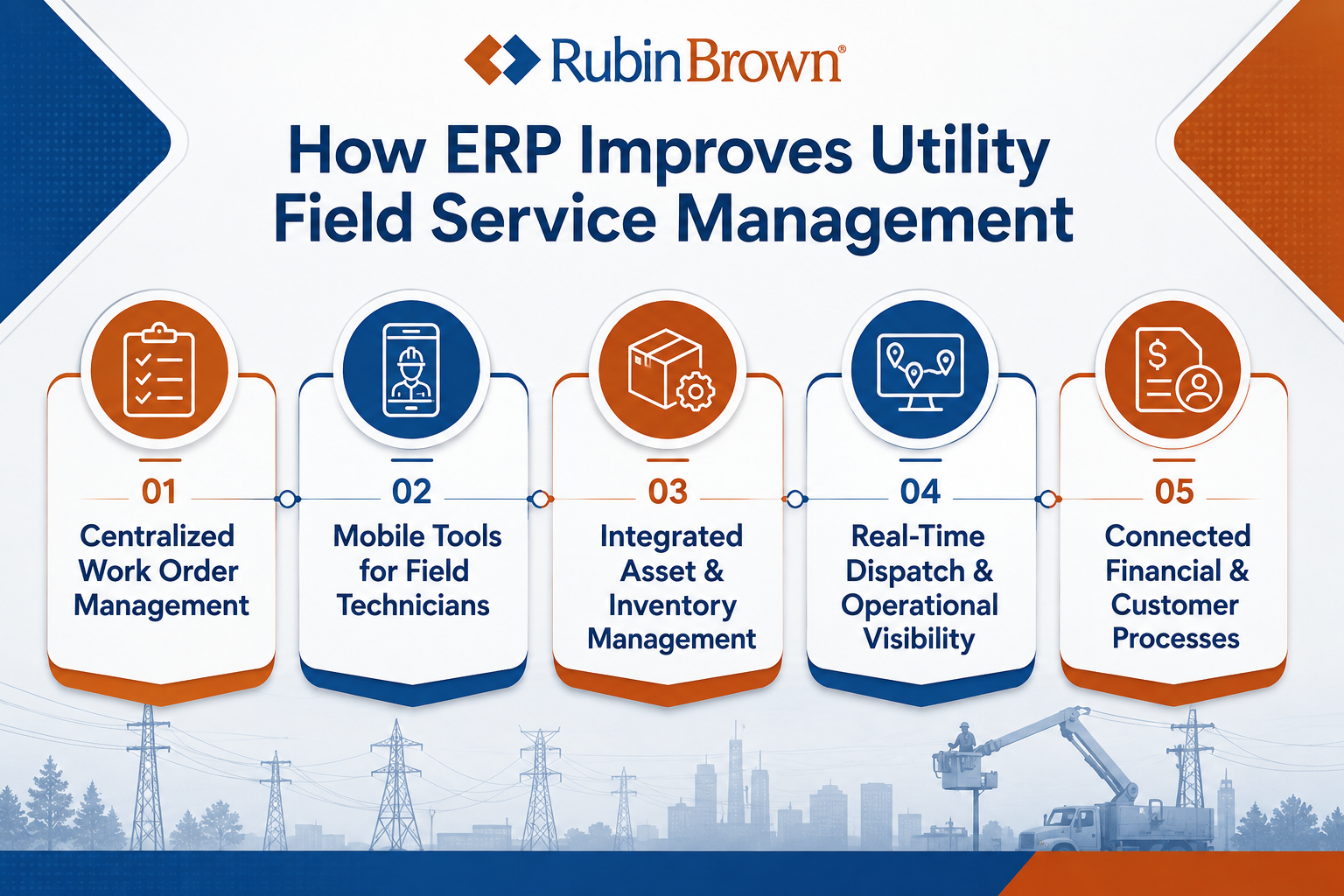
Work orders sit at the center of utility field operations. Every inspection, repair, installation, preventive maintenance activity, and emergency response begins with a work order that must move efficiently between dispatchers, field technicians, supervisors, warehouse personnel, and finance.
An ERP centralizes work order management by giving every team access to the same operational record throughout the service lifecycle. Status updates, labor hours, equipment usage, parts consumption, customer notes, and completion details are captured in one place rather than spread across multiple systems. Managers gain a clearer picture of work in progress, while service teams spend less time reconciling information after the job is complete.
Field technicians make decisions where the work happens, often without immediate access to office staff. Mobile ERP capabilities allow technicians to receive assignments, review asset history, update work orders, capture photos, record inspections, document completed work, and submit service reports directly from the field.
This improves communication between field and office teams while reducing paperwork and duplicate data entry. Supervisors receive timely operational updates, customer service representatives have more accurate job status information, and finance teams can begin downstream processes without waiting for manual documentation to return from the field.
Reliable field service depends on more than technician availability. Crews also need accurate information about asset history, maintenance records, replacement parts, and inventory levels before arriving on site.
By integrating enterprise asset management with inventory management, an ERP gives utilities better visibility into truck stock, warehouse inventory, equipment history, warranty information, and maintenance schedules. Field technicians can confirm parts availability before a service visit, while managers gain better insight into inventory usage, procurement needs, and long-term asset performance.
Read More: Asset Management with an ERP System: A Guide for Energy and Utility
Effective dispatch requires more than assigning the closest technician. Dispatchers also need visibility into crew availability, active work orders, service priorities, equipment status, travel considerations, and inventory constraints to make informed scheduling decisions.
An ERP brings these operational data points together in real time, allowing dispatchers to adjust schedules as priorities change, monitor work in progress, and coordinate resources more effectively during planned maintenance or emergency response. Managers also gain broader visibility into workforce utilization, service backlogs, and operational performance across the utility.
Read Next: From Reactive to Predictive Maintenance: How AI and ERP Transform Utility Asset Management
Field work triggers business processes that extend well beyond the service site. Completed work orders may initiate customer billing, procurement, payroll, project accounting, regulatory reporting, or warranty tracking.
An ERP connects these downstream activities automatically, reducing manual reconciliation between departments and improving reporting accuracy. Instead of re-entering operational data into separate financial systems, utilities can move information directly from completed field work into accounting and customer processes, creating a more consistent and reliable operational workflow.
Read More: How to Build a Data Governance Framework for Your ERP
Many utility organizations struggle with operational issues that extend beyond dispatching or technician scheduling. As field operations grow more complex, disconnected systems can slow response times, reduce visibility, and create unnecessary administrative work across departments.
An integrated ERP addresses these challenges by connecting field service management with asset management, inventory, finance, and customer service, allowing information to move seamlessly throughout the service lifecycle.
These challenges rarely exist in isolation. Improvements in dispatch, work order management, or field service software alone often provide only incremental gains if asset management, inventory, finance, and customer information remain disconnected. Utilities achieve greater operational value when ERP becomes the system that connects every stage of field service delivery.
Selecting an ERP for utility field service management involves more than comparing software features. The platform should support how your organization dispatches field crews, manages assets, tracks inventory, integrates financial processes, and adapts to future operational needs. Evaluating these capabilities together helps ensure the ERP supports both day-to-day field operations and long-term business objectives.
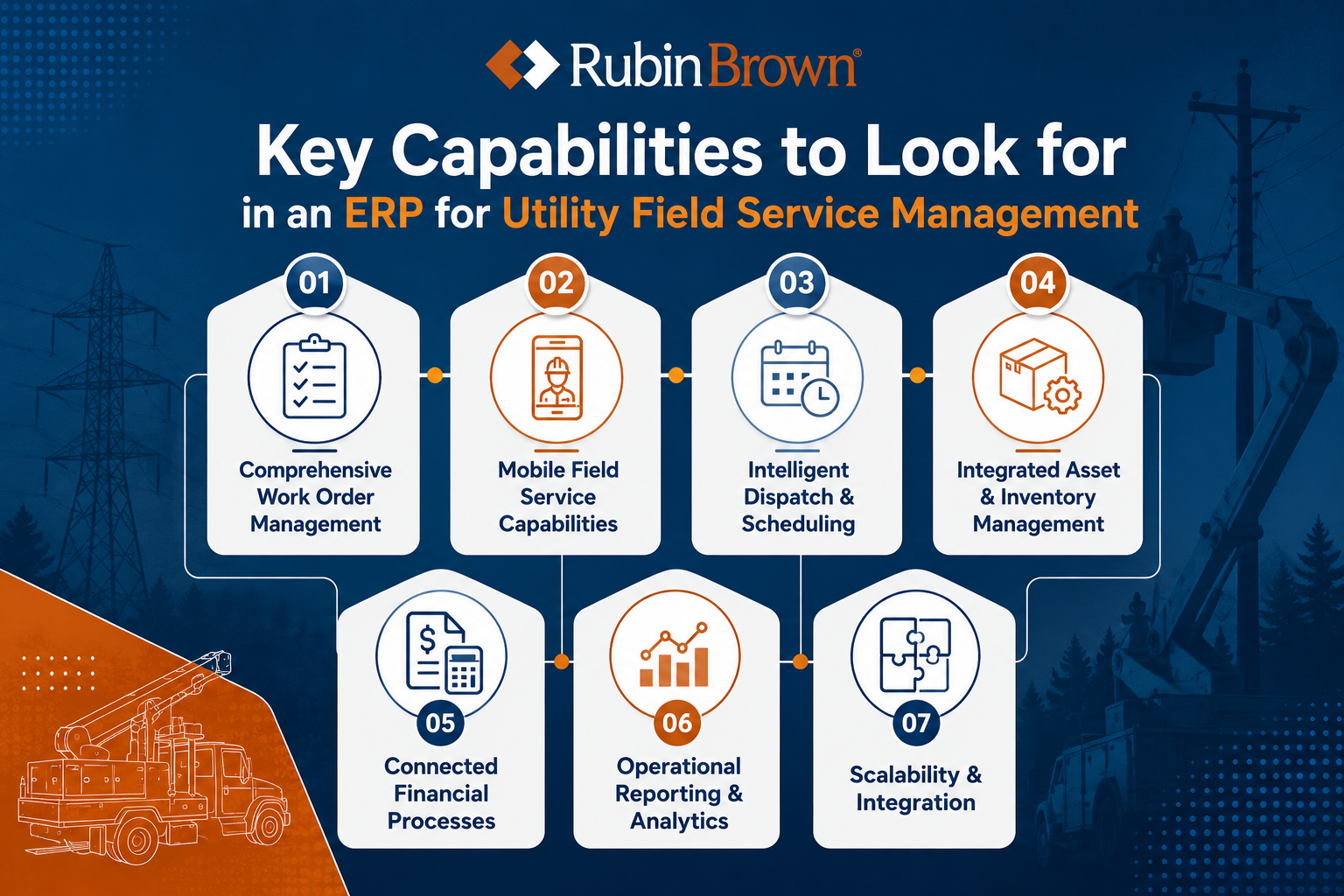
When comparing ERP solutions, prioritize capabilities such as:
Comprehensive work order management. Look for an ERP that centralizes service requests, inspections, preventive maintenance, emergency repairs, and work order history. Every department should have access to the same operational information throughout the service lifecycle.
Mobile field service capabilities. Field technicians should be able to receive assignments, update work orders, capture photos, record field data, and complete service documentation directly from mobile devices, even when working remotely.
Intelligent dispatch and scheduling. Effective field service management software should help dispatchers assign work based on technician availability, location, skills, service priorities, and changing operational conditions.
Integrated asset and inventory management. The ERP should connect enterprise asset management with warehouse inventory and truck stock, giving field crews access to maintenance history, replacement parts, and equipment information before arriving on site.
Connected financial processes. Work completed in the field should flow naturally into customer billing, procurement, payroll, project accounting, and financial reporting without requiring duplicate data entry or manual reconciliation.
Operational reporting and analytics. Managers should be able to monitor service levels, technician utilization, work backlogs, response times, and other key performance indicators using reliable, real-time operational data.
Scalability and integration. Consider how well the ERP integrates with GIS, customer information systems (CIS), outage management systems (OMS), enterprise asset management solutions, and other technologies that support utility operations.
Utilities with fragmented operational data or complex application dependencies may also use RubinBrown's IT and Data Services to assess integration architecture, data quality, governance, security, and reporting requirements before implementation.
No ERP excels in every area, and feature comparisons alone rarely identify the best fit. The goal is to determine whether the platform supports your organization's operating model, integrates with existing systems, and can scale as field operations, infrastructure, and customer expectations evolve.
Read Next: ERP Data Migration vs. Data Integration: Key Differences (And Why You Need Both)
Choosing an ERP for utility field service management requires more than comparing product demonstrations. The evaluation should focus on how well each platform supports your field operations, integrates with existing systems, and adapts to future business needs. An ERP that looks impressive during a demo may still require significant customization if it cannot support the way your organization manages work orders, field crews, assets, and service delivery.
Start by documenting your operational requirements before engaging vendors. Understanding how field work moves from dispatch to completion creates a more objective basis for comparing ERP solutions and helps reduce implementation risk.
Organizations seeking an independent perspective often engage RubinBrown's ERP Advisory Services to define ERP requirements, evaluate vendors, facilitate software selection, and align technology decisions with long-term operational objectives.
Read More: How to Choose an ERP Consultant: Best Practices & ERP Selection Criteria
Instead of relying solely on scripted demonstrations, use questions like these to evaluate how well each ERP aligns with your operational requirements.
Read Next: Top ERP Implementation Risks: 10 Critical Pitfalls to Avoid
These questions help organizations move beyond feature comparisons and evaluate whether an ERP aligns with their operational requirements, integration needs, and long-term business strategy.
Utility field service management depends on more than efficient dispatching or mobile work orders. As field operations become more complex, organizations need systems that connect technicians, assets, inventory, customer service, and financial processes within a single operational environment. An ERP provides that foundation, helping utilities improve visibility, reduce manual coordination, and make more informed operational decisions.
Choosing the right ERP also requires a structured evaluation process. Understanding your operational workflows, integration requirements, reporting needs, and long-term business objectives creates a stronger basis for software selection while reducing implementation risk and unnecessary customization.
Before evaluating ERP vendors, document your current field service processes, identify operational bottlenecks, and establish clear evaluation criteria based on your organization's business objectives. This creates a more consistent selection process and helps ensure the chosen ERP supports both current operations and long-term strategic goals.
If your organization is preparing to modernize utility field service management, RubinBrown's ERP Advisory Services can help you evaluate solutions, reduce implementation risk, and select an ERP that aligns with your operational and business requirements. Talk with RubinBrown's ERP Advisory Team to build a stronger foundation for utility field service management.
Read More: The Ultimate ERP Internal Audit Checklist for CFOs
Field service management software focuses on dispatch, scheduling, work orders, and technician productivity. An ERP system extends those capabilities by connecting field service with finance, procurement, inventory, customer billing, and asset management and maintenance. For utility organizations, combining ERP and field service creates a single operational platform that supports both field execution and enterprise-wide decision-making.
Not necessarily. The best approach depends on the size of the organization, operational complexity, regulatory requirements, and existing technology landscape. Many utilities benefit from an integrated field service ERP that combines work management, financials, inventory, and field operations instead of maintaining separate applications. The goal is to select a solution that supports your operational model rather than adopting software with unnecessary functionality.
While requirements vary, the most valuable field service management software features typically include work order management, mobile access for field technicians, intelligent dispatch, inventory management, asset management, reporting, and integration with GIS, CIS, and other utility applications. These capabilities help utilities improve service delivery while supporting reliable day-to-day operations.
Modern cloud-based field service solutions give field workers and office staff access to the same operational information from virtually anywhere. This improves communication, supports service automation, reduces manual updates, and allows managers to track field activities in real time. When integrated with an ERP, cloud-based field service management technology also improves reporting, operational visibility, and collaboration across departments.
The best field service solution is the one that aligns with your organization's operational requirements, not simply the one with the longest feature list. Before selecting an ERP for field service, document your current workflows, identify integration requirements, and evaluate how each platform supports work management, asset management, financial processes, and long-term scalability. For many organizations in the utility and energy sector, an independent ERP assessment helps ensure the selected management software for utilities supports both current operations and future growth.

Learn how to optimize asset management for the energy sector to improve asset performance, asset reliability, and operational efficiency.

Discover how a construction ERP system improves project management, cost control, and visibility across construction projects for smarter, faster...

ERP for chemical manufacturing helps improve traceability, protect formulas, and streamline compliance across chemical operations.