15 min read
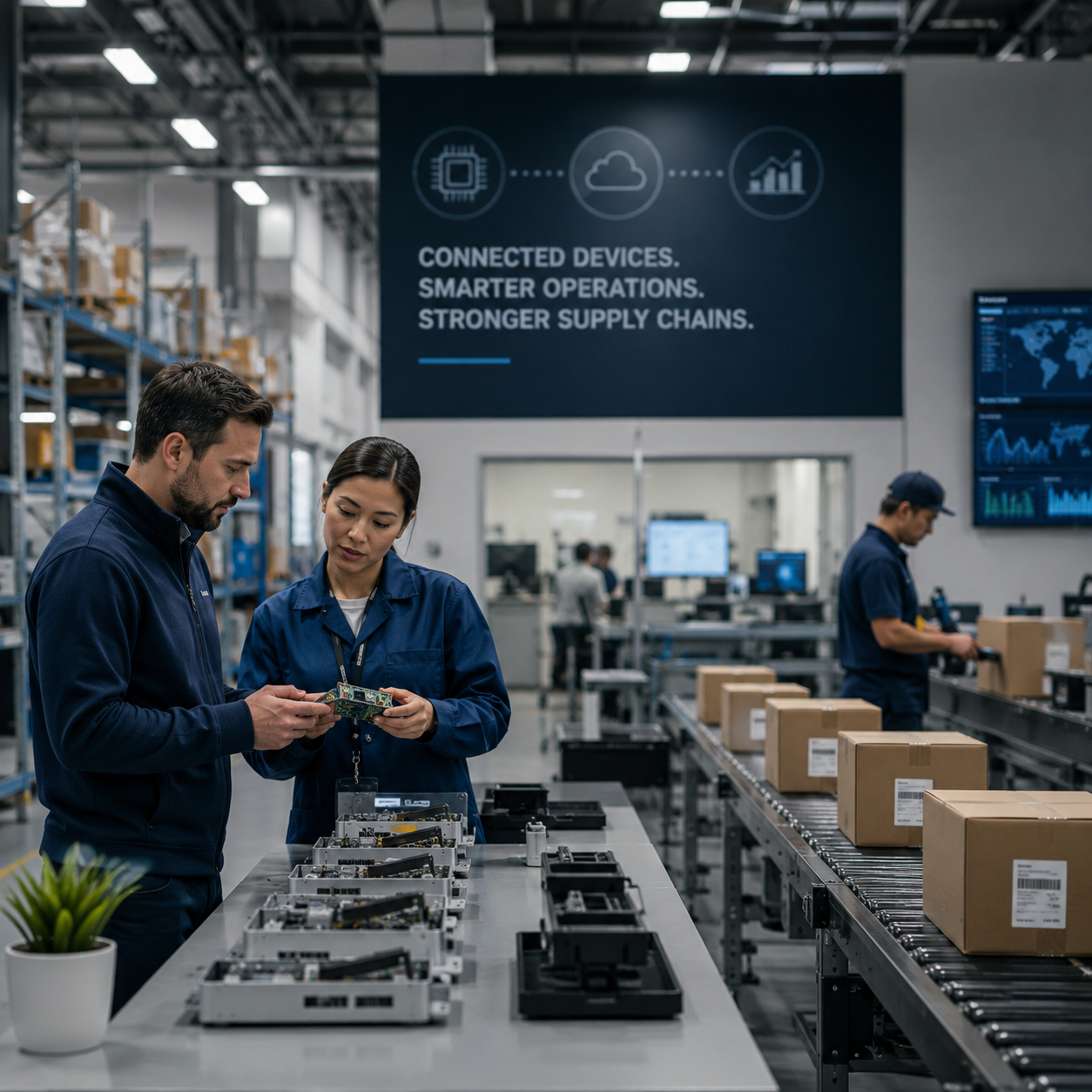
ERP for hardware and IoT companies is a cloud-based platform that integrates complex, multi-level bills of materials with supply chain management, manufacturing operations, warranty tracking, and real-time data streams from connected devices into a unified system.
Unlike traditional ERP systems designed for stable products and centralized operations, modern ERP platforms for hardware manufacturers must handle frequent engineering changes, distributed contract manufacturing networks, component shortages, serialized device tracking, and IoT sensor data that flows continuously from devices in the field.
A 2024 survey of 1,200 manufacturing professionals found that 70% of manufacturers across North America and Europe still describe supply chain navigation as “very” or “extremely” challenging, with lack of operational visibility cited as one of the leading causes. That visibility gap becomes expensive when BOMs live in spreadsheets, supply chain data sits in isolated platforms, and IoT sensor streams never reach the people making procurement, engineering, or warranty decisions.
TL;DR: ERP for Hardware and IoT in One View
-
Complex, multi-level BOMs with frequent engineering changes overwhelm traditional ERP and spreadsheet workflows, creating version control chaos and production errors.
-
ERP for hardware and IoT companies means deep integration across BOMs, supply chain management, manufacturing operations, warranty tracking, and IoT data streams in one central system.
-
Real-time insights depend on connecting ERP data and data from IoT devices through modern ERP platforms with robust integration capabilities and business intelligence layers.
-
AI and machine learning applied to integrated ERP and IoT data improve demand forecasting, supply chain risk management, predictive maintenance, and manufacturing efficiency.
-
Red flags include manual BOM synchronization, blind spots in contract manufacturer inventory, delayed failure analysis, and executives making decisions on week-old data.
-
Industry leaders use cloud ERP platforms integrated with IoT platforms and analytics tools to create a unified architecture that supports real-time data and actionable insights.
-
Working with an independent ERP advisory partner reduces selection risk, prevents vendor lock-in, and accelerates time-to-value through structured requirements, evaluation, and implementation governance.
Why Traditional ERP Fails Hardware and IoT Companies Now
The hardware and IoT manufacturing landscape has fundamentally changed. Industrial IoT adoption, smart manufacturing initiatives, and Industry 4.0 investments are no longer experimental. They are operational imperatives.
Supply chain volatility remains a risk, with lead times for some critical microcontrollers reaching 26 weeks in 2025. The component shortages force manufacturers to manage multiple sourcing strategies, alternate parts, and constant supplier changes. Traditional ERP systems were designed for stable supply chains, predictable BOMs, and centralized manufacturing.
They struggle when the business model depends on real-time visibility, distributed operations, and data integration across physical devices and enterprise software.
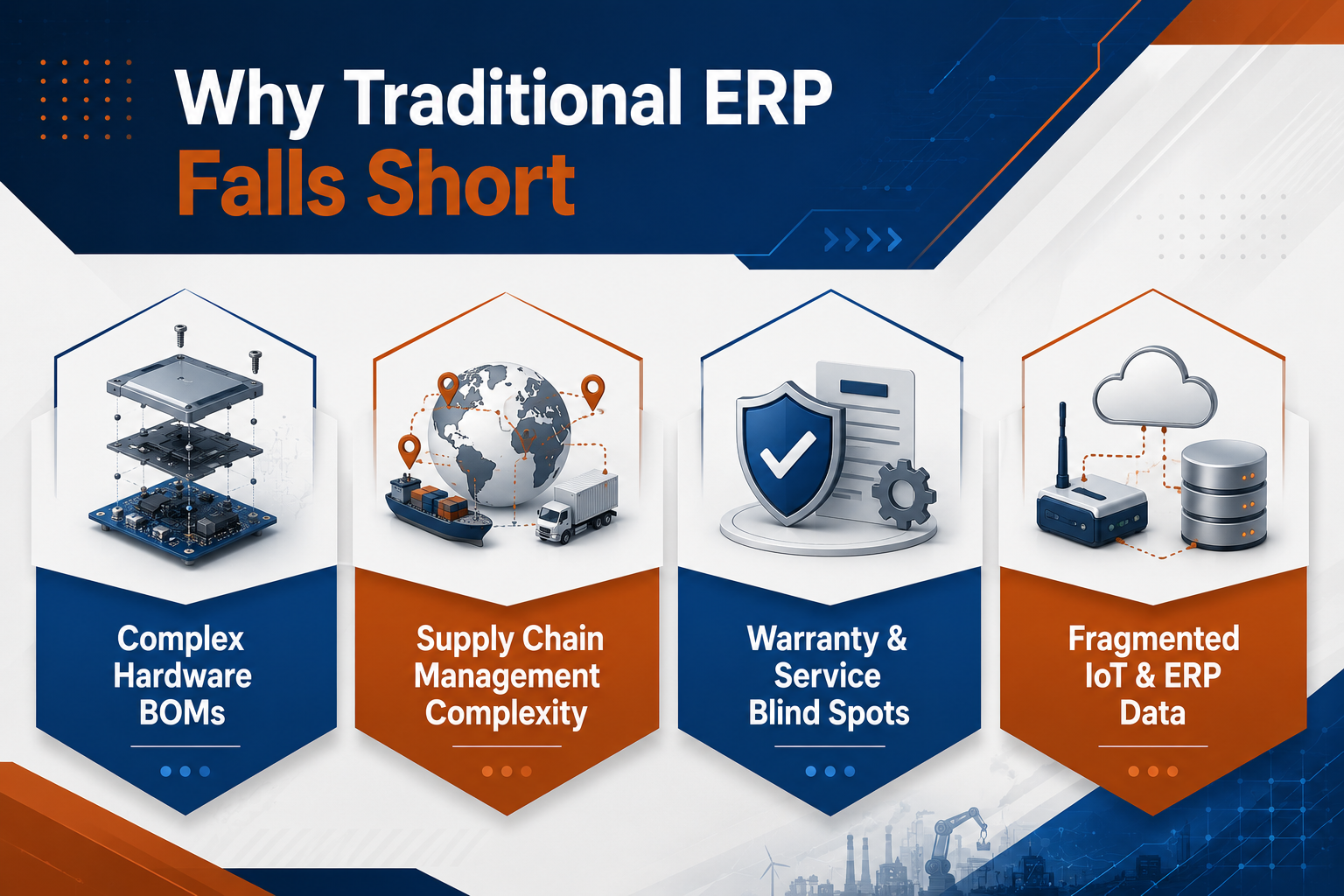
The Complexity of Hardware BOMs and Configurations
Hardware products are not simple assemblies. A single IoT device might include a printed circuit board assembly with dozens of electronic components, mechanical enclosures, firmware, packaging, and documentation. Each of those components may have multiple approved suppliers, revision levels, and effectivity dates.
Multi-level BOMs can extend five or six levels deep, with configurable options that create hundreds of variants from a common platform. Engineering change orders happen frequently as designs evolve, components become obsolete, or field data reveals reliability issues. Traditional ERP systems treat BOMs as static lists.
They lack the revision control, effectiveness management, and change workflow capabilities needed to keep engineering, procurement, and production synchronized. When BOMs live in spreadsheets or disconnected PLM systems, the risk of building products with wrong revisions, unapproved substitutions, or obsolete components becomes unacceptably high. The cost of a single BOM error in a hardware product can cascade through thousands of units in the field.
Supply Chain Management in a Network of Physical Devices
Hardware and IoT companies rarely manufacture everything in-house. Most rely on contract manufacturers, component distributors, and logistics partners spread across multiple countries.
Managing this network requires real-time integration across purchasing, inventory management, production scheduling, and quality control. Legacy ERP systems struggle with this complexity because they were designed for centralized operations, not distributed manufacturing networks.
When IoT sensors on the shop floor detect a quality issue with a specific component lot, that information needs to flow immediately to procurement, engineering, and the contract manufacturer. When a critical component goes on allocation, planners need instant visibility into on-hand inventory, in-transit shipments, work-in-process, and committed demand across all locations.
Spreadsheets and manual data entry cannot keep pace. The result is excess inventory in some locations, shortages in others, and constant firefighting to keep production lines running. Supply chain management for hardware and IoT companies demands a modern ERP platform with deep integration capabilities, real-time data synchronization, and the ability to model complex multi-tier supply networks.
Warranty, Service, and Installed Base Blind Spots
IoT devices create long-tail service obligations. Unlike traditional products that are sold and forgotten, connected devices generate ongoing warranty claims, software updates, field service requests, and replacement part demand for years after initial sale.
Tracking this requires serial number visibility from production through distribution, installation, and service. It requires linking field failure data back to specific BOM revisions, component lots, and manufacturing dates.
Traditional ERPs lack the serial number tracking, installed base management, and service integration needed to manage connected device lifecycles. When a firmware update reveals a hardware defect in a specific production batch, companies need to identify every affected device, notify customers, and manage returns or field replacements. Without integrated ERP and IoT data, this becomes a manual, error-prone process that damages customer relationships and inflates warranty costs.
The feedback loop between field performance and product design remains broken because IoT sensor data never reaches the people making BOM and supplier decisions.
Fragmented IoT and ERP Data
IoT devices capture real-time data on usage patterns, performance metrics, environmental conditions, and failure modes. This data has enormous value for improving product design, optimizing supply chains, and predicting service needs. But in most organizations, IoT data streams remain siloed in separate platforms, disconnected from the ERP systems that manage BOMs, inventory, production, and financials. ERP systems are designed as systems of record, providing transaction integrity and financial control.
IoT platforms are designed for high-volume data ingestion, real-time analytics, and device management. Both are necessary, but without integration, executives cannot analyze IoT data and ERP data together to generate business intelligence.
They cannot answer questions like: Which component suppliers correlate with higher field failure rates? How does actual device usage compare to demand forecasts? What is the true cost of warranty when you factor in logistics, labor, and lost customer trust? Fragmented data means fragmented decisions, and fragmented decisions mean missed opportunities and avoidable costs.
Read Next: 10 Signs Your Business Processes Are Broken and Slowing You Down
What ERP for Hardware and IoT Companies Must Actually Do
Selecting an ERP solution for hardware and IoT companies requires a clear understanding of the capabilities that matter. What matters is whether the ERP platform can handle the specific workflows, data structures, and integration patterns that hardware and IoT device manufacturers depend on every day.
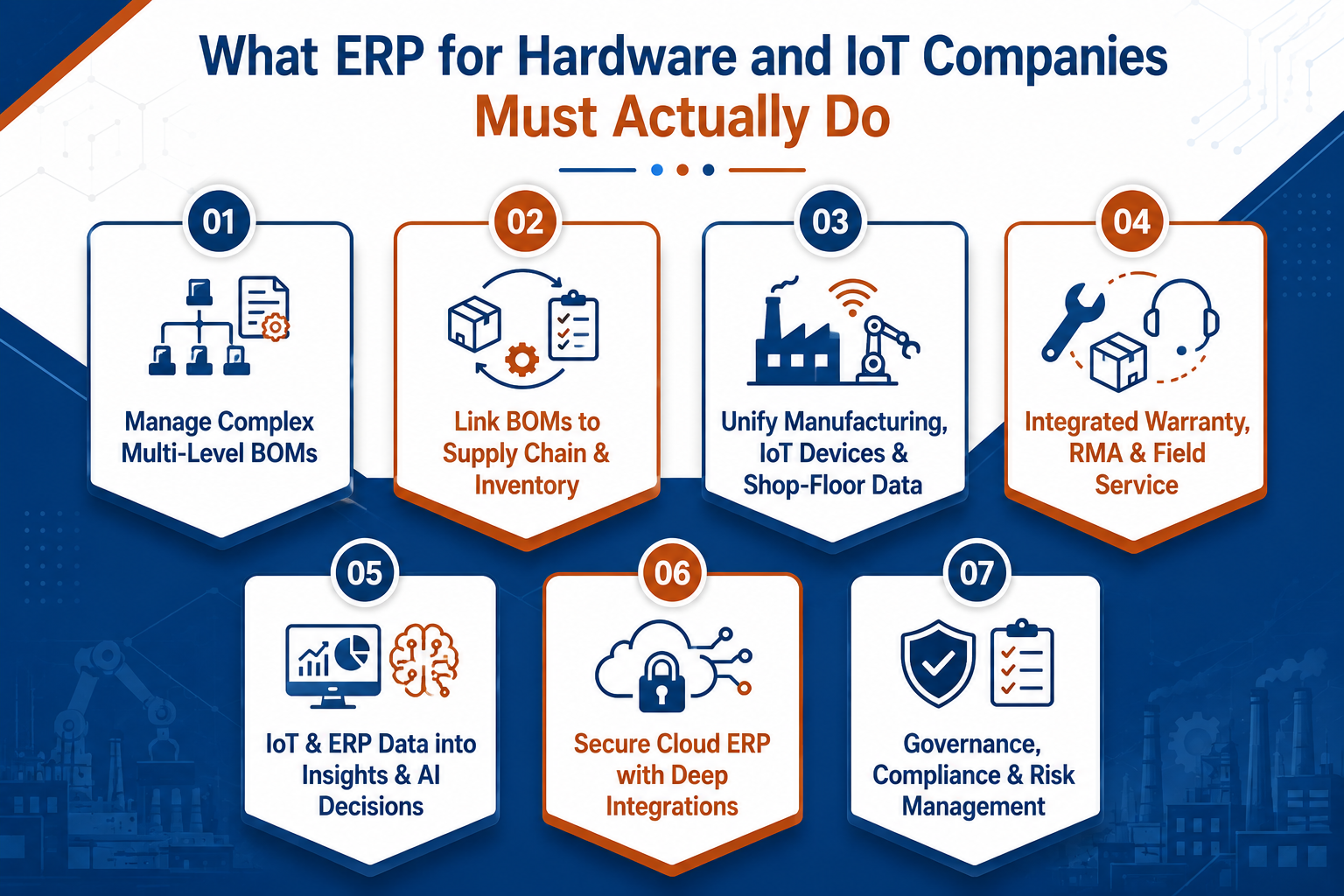
1. Manage Complex, Multi-Level BOMs and Engineering Change in One Central System
Hardware products require multi-level BOMs that capture assemblies, sub-assemblies, components, and raw materials with full traceability.
A modern ERP platform must support configurable BOMs with options and variants, effective dates that control when specific components or revisions are valid, and engineering change workflows that ensure all stakeholders review and approve changes before they affect production. Integration with CAD and PLM systems should be seamless, allowing engineering changes to flow into the ERP system without manual re-entry.
The ERP system must serve as the central system of record for BOMs and revisions, ensuring that procurement, production, and service all work from the same accurate data. When IoT sensors monitor equipment failures in the field and engineering identifies a design improvement, the ERP system must support rapid, controlled updates to BOMs and production schedules.
Buyers should ask: How does the ERP system handle multi-level BOMs with more than five levels? Can it manage effective dates and alternate components? What engineering change management workflows are built in, and how do they integrate with PLM? How does the system prevent production from using obsolete or unapproved BOM revisions?
2. Link BOMs to Real-Time Supply Chain and Inventory Management
BOMs drive material requirements planning, purchasing decisions, production schedules, and inventory allocation. A modern ERP platform must connect BOMs directly to supply chain management and inventory management processes with real-time visibility and automated workflows.
-
Real-time material visibility: The ERP system must provide instant visibility into inventory levels, locations, and status across the entire supply network, including contract manufacturers and third-party logistics providers, eliminating the blind spots that cause shortages and excess inventory while enabling accurate promise dates and production planning.
-
Automated replenishment triggers: Integration with IoT sensors and production systems should automatically trigger purchase requisitions, transfer orders, or production orders when inventory falls below defined thresholds, reducing manual intervention and improving responsiveness to demand changes or unexpected consumption spikes.
-
Alternate and substitute management: The system must support approved alternates and substitutes at the component level, allowing procurement and production to respond quickly to shortages or obsolescence without waiting for engineering change orders, while maintaining traceability and ensuring only approved components are used.
-
Multi-tier supplier visibility: The platform should provide visibility into multi-tier supplier relationships, tracking not just direct suppliers but also their key sub-suppliers for critical components, enabling early identification of supply chain risks and proactive mitigation before shortages impact production schedules.
-
Supplier performance tracking: Integration of supply chain data with quality and delivery metrics enables continuous supplier evaluation, helping procurement teams identify risks and optimize sourcing strategies based on real performance data, including on-time delivery rates, quality defect rates, and responsiveness to engineering changes.
Read Next: ERP Data Migration Checklist: Best Practices for Success
3. Unify Manufacturing Operations, IoT Devices, and Shop-Floor Data
Manufacturing efficiency depends on real-time visibility into what is happening on the shop floor. ERP and IoT integration enables this by connecting IoT sensors, barcode scanners, machine controllers, and manufacturing execution systems directly to the ERP platform.
Use cases include tracking machine uptime and downtime, monitoring production counts and scrap rates, detecting quality issues in real time, and triggering predictive maintenance workflows before equipment failures disrupt production.
When IoT devices capture data on machine status, cycle times, and material consumption, that data can update ERP records automatically, eliminating manual data entry and providing accurate, real-time information for production planning, costing, and performance analysis.
This integration transforms the ERP system from a transaction recorder into an operational tool that supports continuous improvement, faster problem resolution, and better resource utilization. Manufacturers using IoT integration report up to 30% reductions in downtime and 18% improvements in energy efficiency.
4. Build an Integrated Warranty, RMA, and Field Service Model
Connected devices create ongoing service obligations that extend years beyond the initial sale. Managing this requires an ERP system that integrates warranty, return merchandise authorization, and field service processes with serial number tracking and IoT data streams.
-
Serial number traceability: The ERP system must track serial numbers from production through the entire product lifecycle, linking each device to its specific BOM revision, component lot numbers, manufacturing date, and service history for complete traceability that enables targeted recalls, root cause analysis, and supplier recovery claims.
-
Automated service case creation: Integration with IoT platforms should automatically generate service cases when sensor data indicates potential failures, pre-populating case details with device configuration, location, failure symptoms, and service history to accelerate response times and improve first-time fix rates.
-
Integrated RMA workflows: RMA processes must connect to inventory and financial systems, ensuring that returned products are received, inspected, and processed efficiently while updating warranty cost accruals, triggering supplier recovery claims for defective components, and providing visibility into return reasons and trends.
-
Warranty cost analytics: The system must capture all warranty-related costs, including parts, labor, logistics, and administrative overhead, and link them to specific products, component suppliers, and failure modes to support data-driven design and sourcing decisions that reduce the total cost of quality.
-
Installed base visibility: Real-time visibility into the installed base, including device locations, configurations, software versions, and usage patterns, enables proactive service, targeted software updates, accurate forecasting of replacement part demand, and identification of opportunities for upgrades or new service offerings.
5. Turn IoT and ERP Data into Real-Time Insights and AI-Driven Decisions
Modern ERP platforms must do more than store transactions. They must support real-time insights and business intelligence by integrating ERP data with data from IoT devices and enabling advanced analytics. This requires a centralized platform that can ingest, store, and analyze data from multiple sources, including production systems, supply chain partners, IoT sensors, and financial systems.
Machine learning and AI use cases include demand forecasting that incorporates actual device usage patterns, supply chain risk scoring that identifies vulnerable suppliers or components before shortages occur, anomaly detection in IoT data that flags quality issues or equipment failures, and predictive maintenance models that optimize service schedules and reduce downtime. The key is integration. AI and machine learning algorithms are only as good as the data they can access.
When ERP and IoT data remain siloed, analytics efforts deliver limited value. When they are integrated in a modern ERP platform with robust data management and analytics capabilities, they enable actionable insights that improve operational efficiency, reduce costs, and support faster, more accurate decisions.
6. Support Secure, Cloud-Based ERP with Deep Integration Capabilities
Cloud ERP software offers significant advantages for hardware and IoT companies, including scalability to handle growing data volumes from IoT devices, flexibility to integrate with diverse systems, and agility to deploy updates without lengthy upgrade cycles.
-
API-first architecture: The ERP platform should provide well-documented, modern APIs that enable real-time integration with IoT platforms, MES systems, supply chain partners, and analytics tools without requiring custom middleware or complex integration projects that increase cost and maintenance burden.
-
Event-driven integration: Support for event-driven architectures allows the ERP system to respond immediately to events from IoT devices, production systems, or supply chain partners, enabling real-time workflows such as automated replenishment, quality alerts, or service case creation that reduce latency in critical business processes.
-
Prebuilt connectors: Availability of prebuilt connectors for common IoT platforms, cloud services, and industry-standard protocols reduces integration time, cost, and risk compared to building custom integrations from scratch, while ensuring ongoing support and updates as platforms evolve.
-
Scalability and performance: The cloud architecture must handle high-volume data ingestion from thousands or millions of IoT devices, support concurrent users across global locations, and maintain performance as transaction volumes grow without requiring infrastructure upgrades or performance tuning.
7. Embed Governance, Compliance, and Risk Management Into Business Processes
Hardware and IoT companies face complex regulatory, security, and safety requirements. Export controls restrict where certain technologies can be shipped. Data privacy regulations govern how customer and device data can be collected, stored, and used. Product safety reporting requirements mandate traceability and rapid response to field issues.
The ERP system must embed these requirements into business processes through automated controls, approval workflows, and audit trails. For example, the system should prevent shipments to restricted countries, enforce data retention and deletion policies, and maintain complete traceability from raw materials through finished products and field service. Independent ERP advisory partners play a critical role in aligning ERP controls with the organization's risk posture, ensuring that compliance requirements are built into system design and configuration rather than bolted on later.
This reduces the risk of compliance failures, simplifies audits, and ensures that the ERP system supports rather than hinders the organization's ability to operate in regulated markets.
Read Next: ERP Controls for SOX Compliance: A CFO's Guide to Audit-Ready Systems
How Do You Compare ERP Architectures for Hardware and IoT?
Hardware and IoT companies evaluating ERP options encounter three common architectural patterns. Each represents a different level of integration, capability, and strategic alignment. Understanding these patterns helps decision-makers assess where their organization is today, where it needs to be, and what investment is required to close the gap.
RubinBrown's Digital Transformation services help hardware and IoT companies develop and implement digital strategies that align business objectives with technology capabilities, including ERP platforms, IoT integration, cloud strategy, and data management, regardless of company size or industry.
What Steps Turn Requirements into an Actionable ERP Roadmap?
Moving from concept to execution requires a structured approach. Hardware and IoT companies that succeed with ERP implementations follow a disciplined process that starts with clear requirements, engages stakeholders across the organization, and de-risks selection and implementation through independent advisory and strong governance.
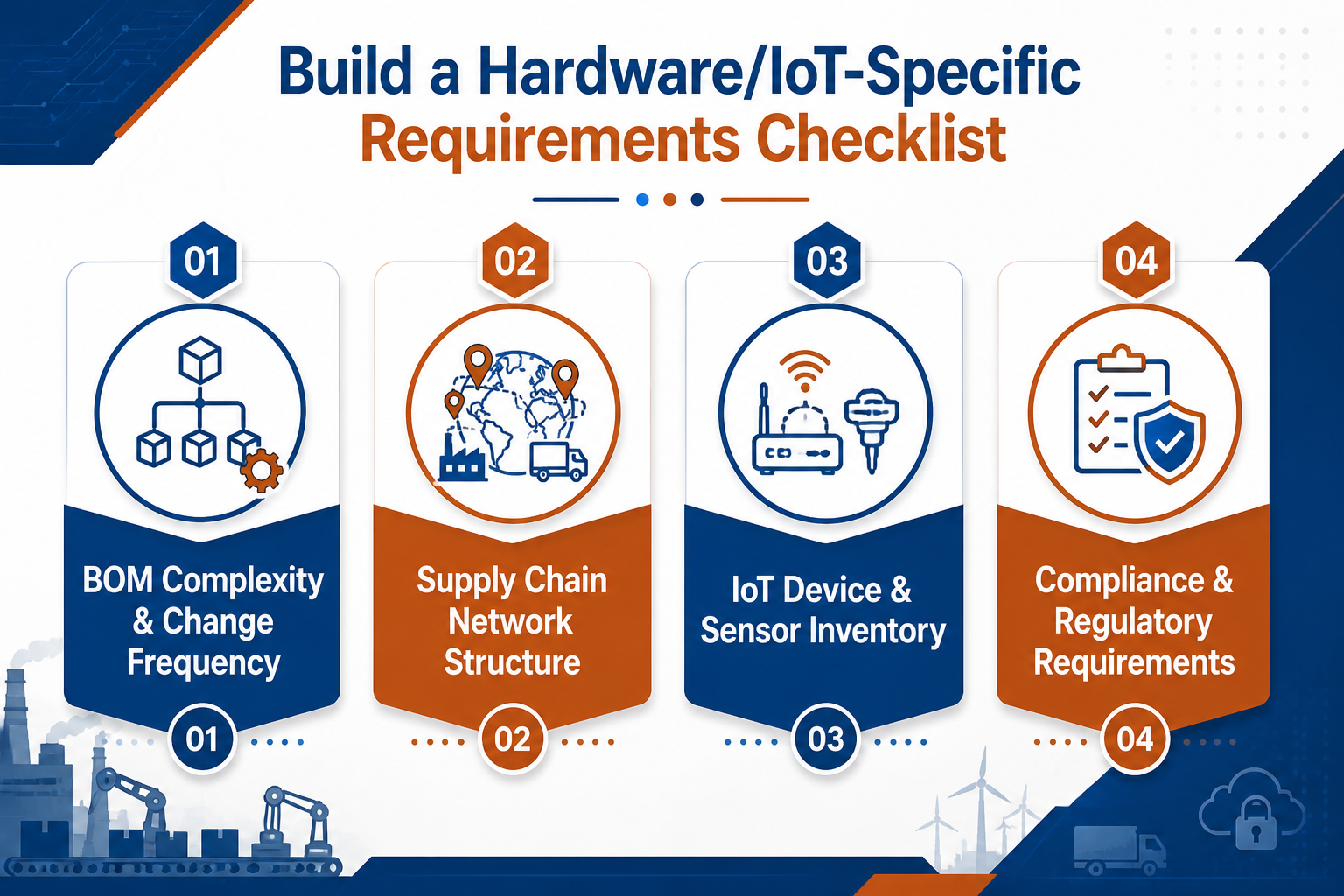
Build a Hardware/IoT-Specific Requirements Checklist
BOMs drive material requirements planning, purchasing decisions, production schedules, and inventory allocation. A modern ERP platform must connect BOMs directly to supply chain management and inventory management processes with real-time visibility and automated workflows.
-
BOM complexity and change frequency: Document the maximum number of BOM levels, typical number of components per product, frequency of engineering changes, and requirements for managing effectivity dates, alternates, and configurable options to ensure the ERP system can handle your product complexity.
-
Supply chain network structure: Map the complete supply chain network, including the number and location of contract manufacturers, distribution centers, and key suppliers, along with integration requirements for real-time data exchange and collaborative planning.
-
IoT device and sensor inventory: Create a comprehensive inventory of IoT devices, sensors, and data sources that must integrate with the ERP system, specifying data types, update frequencies, and business processes that depend on real-time IoT data.
-
Compliance and regulatory requirements: Document all regulatory requirements that affect ERP processes, including export controls, data privacy laws, product safety reporting, and industry-specific compliance obligations, to ensure the system supports required controls and audit trails.
Align Stakeholders Around Architecture and Decision Criteria
ERP selection and implementation affect every part of the organization. Success requires engaging engineering, manufacturing, supply chain, finance, service, and IT teams early and ensuring they align around a shared vision of success.
Define what success looks like in concrete terms: operational efficiency improvements, real-time insights that enable faster decisions, financial results such as reduced inventory carrying costs or lower warranty expenses, and strategic capabilities such as new service business models enabled by IoT data.
Document selection criteria and weighting, ensuring that the evaluation process considers functionality, integration capabilities, total cost of ownership, vendor stability and support, and change management requirements. This alignment process ensures that the organization understands the trade-offs, commits to the investment required, and prepares for the change management effort that successful ERP implementation demands.
De-Risk Selection and Implementation with Independent Advisory
The difference between successful and failed ERP projects often comes down to governance, risk management, and independent oversight. An independent, technology-agnostic ERP advisor brings experience across multiple ERP platforms and implementation partners, enabling objective evaluation without vendor bias.
Structured ERP advisory services include requirements definition, vendor and implementation partner selection, contract negotiation, implementation governance, and project leadership. Business process reengineering ensures that the organization does not simply automate existing inefficient processes but redesigns workflows to take advantage of modern ERP and IoT integration capabilities.
Independent advisors reduce scope creep by maintaining clear requirements and managing change requests, mitigate compliance risk by ensuring controls are built into system design, and prevent project failure by identifying and addressing issues early. Organizations should bring in external support during ERP selection to ensure objective evaluation and avoid costly mistakes, during implementation to provide governance and risk management, or for project recovery when implementations stall or fail to deliver expected value.
Read Next: Best ERP Solution Providers: Compare Top ERP Vendors & Systems
Designing the Nerve Center of Your Hardware Business
Traditional ERP systems and spreadsheets are no longer enough. Integrating ERP and IoT delivers real-time insights and actionable intelligence that improve forecasting, reduce costs, accelerate problem resolution, and enable new business models.
But technology alone does not guarantee success. Disciplined selection, structured implementation, and strong governance matter as much as the software itself. Organizations that treat ERP as a business transformation initiative, engage stakeholders across functions, and work with independent advisors to de-risk the journey, achieve better outcomes with less disruption.
Key takeaways:
-
Capability focus: ERP for hardware and IoT companies must manage multi-level BOMs, integrate supply chain and manufacturing operations, track serialized devices through warranty and service, and connect IoT data streams to business processes and analytics in real time.
-
Architecture matters: Industry leaders use cloud ERP platforms deeply integrated with IoT platforms and analytics tools to create a unified architecture that supports real-time data, AI-driven insights, and operational efficiency across distributed operations.
-
Governance and execution: Success depends on structured requirements, objective evaluation, strong implementation governance, and business process reengineering to ensure the ERP system aligns with business objectives and delivers measurable value rather than just replicating existing inefficient processes.
RubinBrown offers ERP Advisory services across the full ERP lifecycle, including software assessment and strategy, software selection, ERP verification and validation, implementation partner selection, enterprise software procurement and negotiation, active ERP project management, and ERP project rescue and recovery, with an emphasis on time-to-value and risk reduction.
Book a consultation call to evaluate your ERP and IoT integration requirements with an advisor who understands hardware manufacturing complexity and prioritizes getting it right the first time.
FAQs
What makes ERP for hardware and IoT companies different from traditional manufacturing ERP?
ERP for hardware and IoT companies must handle multi-level, configurable BOMs with frequent engineering changes, distributed manufacturing across contract manufacturers, serial number tracking for warranty and service, and real-time integration with IoT devices and sensors. Traditional manufacturing ERP systems were designed for stable products and centralized operations, lacking the revision control, IoT connectivity, and real-time integration capabilities that hardware manufacturers require.
How does ERP and IoT integration improve real-time visibility into supply chain and production?
ERP and IoT integration connects sensors, scanners, and machine controllers directly to the ERP platform, eliminating manual data entry and providing instant updates on inventory levels, production status, machine performance, and quality metrics. This enables real-time tracking across the entire supply chain, automated workflows triggered by IoT events, and faster problem identification before disruptions impact production or customer deliveries.
Which BOM and engineering change capabilities are critical for hardware and IoT manufacturers?
Critical capabilities include multi-level BOMs with at least five to six levels, configurable BOMs for product variants, effectivity dates controlling when components are valid, alternate component management for flexible sourcing, structured engineering change workflows with version control, and integration with PLM and CAD systems. Without these, organizations face version control chaos, production errors, and an inability to respond quickly to field issues or component obsolescence.
How should ERP handle warranty, RMA, and field service for connected devices?
The ERP system must integrate warranty, RMA, and field service with serial number tracking, installed base management, and IoT data streams. This includes tracking every device from production through service, automated service case creation when IoT sensors indicate failures, RMA workflows connected to inventory and financials, and feeding IoT data into warranty cost analysis to identify trends and quantify the financial impact of design or supplier issues.
What are the main options for integrating IoT platforms and IoT sensors with ERP systems?
Main integration options include API-based integration for real-time data synchronization, event-driven integration using message queues for immediate response to IoT events, prebuilt connectors that reduce development time for common platforms, and middleware or integration platforms providing centralized data flow management. Cloud ERP platforms generally offer better integration capabilities through modern API-first architectures designed for distributed, connected environments.
How can AI and machine learning use ERP data and data from IoT devices to improve forecasting?
AI and machine learning improve forecasting by analyzing patterns in integrated ERP and IoT data, incorporating actual device usage patterns from IoT sensors rather than just historical sales, identifying correlations between usage and replacement part demand, and using supply chain data combined with external factors to predict and mitigate risks. The key is integration: algorithms require comprehensive, high-quality data from both ERP systems and IoT devices to generate accurate, actionable insights.
What signs indicate our current ERP system is holding back hardware and IoT growth?
Warning signs include manual BOM synchronization between systems, blind spots in contract manufacturer inventory forcing reliance on emails and spreadsheets, delayed failure analysis because IoT data is disconnected from ERP, executives making decisions on week-old data, frequent production errors from wrong BOM revisions, inability to track warranty costs by component or supplier, and difficulty responding to component shortages due to a lack of visibility into multi-tier supplier relationships.
How can an independent ERP advisory partner help de-risk ERP selection and implementation?
Independent advisors provide objective, vendor-agnostic guidance throughout the ERP lifecycle, helping organizations define clear requirements, evaluate platforms without vendor bias, negotiate favorable contracts, and provide implementation governance and project leadership. They bring experience across multiple ERP platforms to identify potential issues early, apply proven methodologies that reduce time and cost, and offer project recovery services when implementations stall or fail to deliver expected value.