ERP Implementation Failure Rate: Why ERP Projects Fail
ERP systems are designed to streamline operations and drive business value, but for many organizations, the reality falls short. Implementing an ERP...
4 min read

Enterprise Resource Planning (ERP) implementations are complex, high-stakes initiatives, but defining success goes far beyond simply going live. According to Panorama Consulting Group’s 2025 ERP Report, organizations often realize gains in efficiency and cost reduction, but outcomes vary significantly depending on how success is measured.
ERP transformation metrics provide a structured way to evaluate performance, measure ROI, and ensure your ERP system delivers meaningful business impact. For example, organizations that effectively track ERP success most commonly report improvements in productivity and efficiency (81.8%), IT maintenance costs (79.8%), and operating and labor costs (70.1%).
ERP transformation metrics are key performance indicators (KPIs) used to evaluate the success of an ERP implementation across financial performance, operational efficiency, system adoption, and overall business impact.
They provide organizations with a structured way to measure whether their ERP system is delivering expected value, identify performance gaps, and align technology outcomes with strategic business goals. Common ERP transformation metrics include return on investment (ROI), user adoption rates, process efficiency improvements, data accuracy, and system performance.
Implementing an ERP system is only the first step. Measuring its impact is what determines whether it delivers real business value. ERP implementations require significant investments in time, resources, and organizational change.
Without clearly defined success metrics, organizations risk falling short of expected outcomes, even if the system is delivered on time and within budget. Measuring ERP success also helps secure stakeholder buy-in by providing clear, data-driven insights into performance and value. It enables organizations to:
A structured approach to measurement ensures your ERP system is not just implemented, but is also continuously delivering value across the organization.
By leveraging key metrics and fostering a culture of data-driven decision-making, you can ensure your ERP implementation is not just a project, but a strategic driver of success for your organization. While each organization should tailor key performance indicators (KPI) to track according to their unique needs, here are 9 metrics that your business can use to measure ERP implementation success:
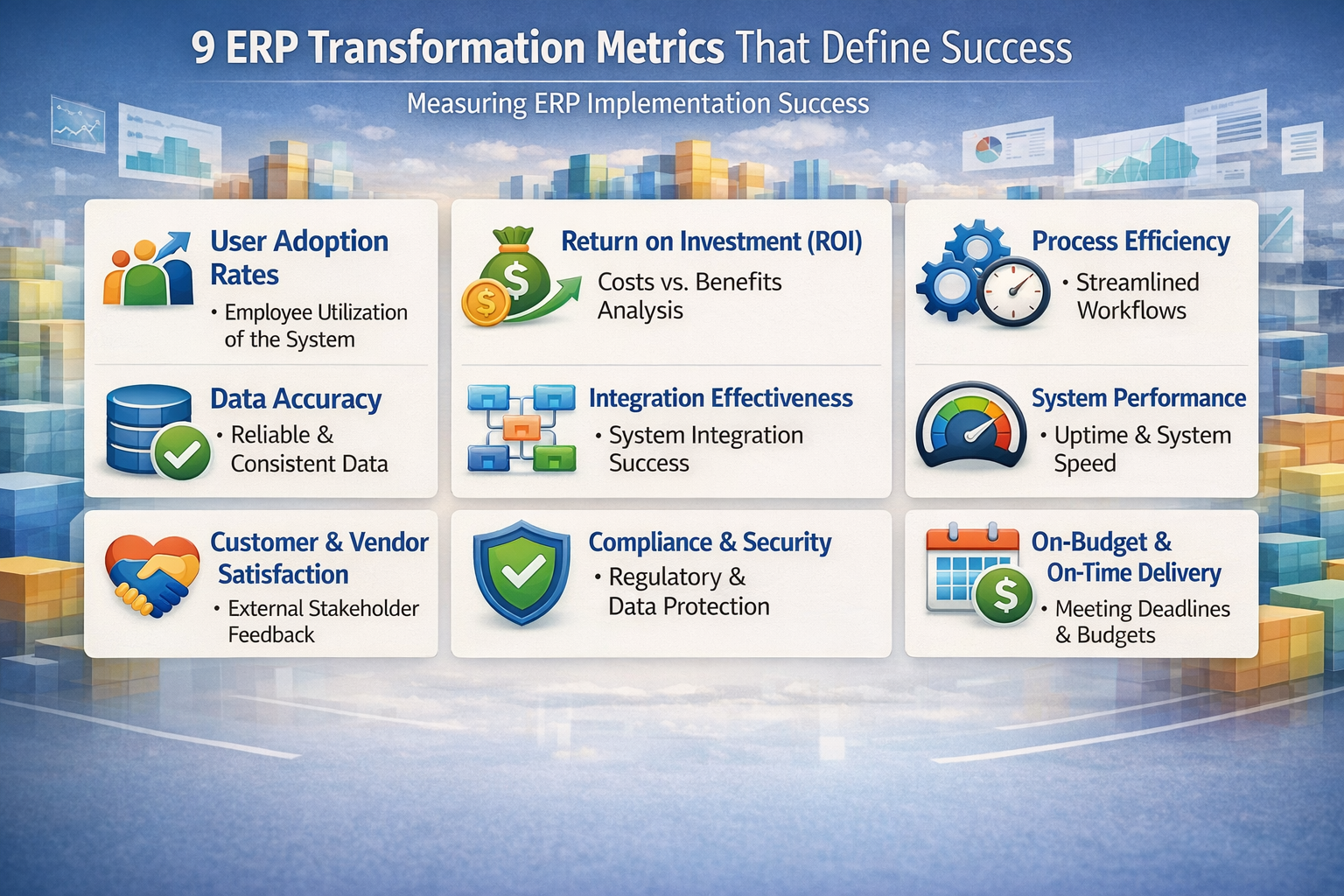
The heart of any ERP system's success is user adoption. Track the percentage of employees effectively utilizing the new system compared to the total number of users. High adoption rates indicate that the system aligns with user needs and is intuitive, while low rates may signal the need for additional training or system adjustments.
One of the most critical metrics in evaluating ERP success is the return on investment. Calculate the ROI by comparing the gains achieved through the ERP system, such as increased productivity, cost savings, and revenue growth, against the total investment in the implementation. A positive ROI signifies that the ERP system is contributing to the organization's financial health.
Evaluate how well the ERP system has streamlined existing business processes. Measure the time and resources saved by employees, the reduction in manual errors, and improvements in task completion times. Increased efficiency in day-to-day operations is a strong indicator that the ERP implementation is delivering tangible benefits.
An ERP system's success is heavily reliant on the accuracy and integrity of data. Monitor data entry errors, duplication rates, and the consistency of information across the organization. A high level of data accuracy ensures that decision-makers can rely on system-generated insights for strategic planning and informed decision-making.
Assess the ERP system's ability to integrate seamlessly with other existing business applications. Successful integration enhances cross-functional collaboration and ensures a unified data flow across the organization. Evaluate how well the ERP system connects with other systems, such as CRM, supply chain, and HR, to maximize its impact on overall business operations.
Measure the ERP system's uptime and performance to ensure continuous accessibility and functionality. Excessive downtime or sluggish performance can hinder productivity and frustrate users. Monitoring these metrics helps identify potential system issues and allows for proactive measures to maintain optimal performance.
Extend the evaluation beyond internal stakeholders and consider the satisfaction levels of customers and vendors. A successful ERP implementation should positively impact customer service, order fulfillment, and overall vendor relationships. Gather feedback from external parties to gauge the system's impact on the entire supply chain and customer experience.
Verify that the ERP system aligns with industry regulations and standards. Evaluate the effectiveness of security measures in place to protect sensitive data. Compliance with legal requirements and robust cybersecurity measures is crucial for maintaining trust and safeguarding the organization's reputation.
The greatest ERP implementation in the world will not be a success if it exceeds its budget and fails to deliver on its planned timeline to a degree that is detrimental to the organization’s livelihood. By tracking actual vs. planned deliverable dates and costs, organizations can help identify sectors that require attention to keep the project on track.
While tracking individual metrics is essential, leading organizations evaluate ERP success through a structured framework that connects performance data to broader business outcomes. ERP transformation metrics can be grouped into four key categories:
Financial Metrics
Measure the direct business impact of your ERP system, including return on investment (ROI), cost savings, and revenue improvements.
Operational Metrics
Evaluate how effectively your ERP system improves business processes, including efficiency gains, cycle time reductions, and error minimization.
Adoption Metrics
Assess how well employees are using the system, including user adoption rates, engagement levels, and overall user satisfaction.
System Performance Metrics
Track the reliability and technical effectiveness of the ERP system, including uptime, integration performance, and data accuracy.
By organizing ERP transformation metrics into these categories, organizations can move beyond isolated KPIs and gain a more comprehensive view of implementation success.
ERP success is not a one-time milestone. It requires continuous measurement and optimization. Regularly review your chosen metrics, adjust them as needed, and use the insights to continuously refine your ERP implementation for optimal performance and sustained value creation. And don’t forget to:
Contact RubinBrown today for help focusing on the right metrics that can unlock the full potential of your ERP implementation and ensure it’s a success by delivering lasting value to your organization.

ERP systems are designed to streamline operations and drive business value, but for many organizations, the reality falls short. Implementing an ERP...

Selecting and implementing an enterprise resource planning (ERP) system can be a complex and high-stakes endeavor, but embracing the right strategies...

Enterprise Resource Planning (ERP) systems play a crucial role in the manufacturing industry by helping organizations streamline their operations,...