10 Signs Your Business Processes Are Broken and Slowing You Down
Learn 10 signs your business process is inefficient. Discover how broken workflows and inefficient processes may be quietly hurting your business.
13 min read

Business Process Reengineering (BPR) and Business Process Improvement (BPI) both improve business processes, but they serve different purposes. BPI focuses on incremental improvements to existing workflows, while BPR involves fundamentally redesigning business processes to achieve more significant operational change.
The distinction matters because transformation challenges are often process challenges first. Deloitte's 2025 Tech Value Survey found that misaligned incentives ranked as the top barrier to digital transformation, followed by legacy systems, lack of internal technical expertise, security concerns, lack of a transformation strategy, and insufficient funding. These challenges often signal whether an organization should optimize existing processes or pursue more extensive process redesign before investing in new technology, automation, or ERP initiatives.
For transformation leaders, the key question is simple: Do your business processes need refinement or reinvention?
P.S. Organizations evaluating process redesign, ERP modernization, digital transformation, or operational improvement initiatives often benefit from independent advisory support. RubinBrown's Business Transformation Services help organizations assess current-state operations, identify process constraints, align technology investments with business objectives, and develop practical transformation roadmaps.
Business Process Improvement (BPI) is one of the most common approaches organizations use to improve operational performance. Rather than rebuilding business processes from the ground up, BPI focuses on identifying inefficiencies, removing bottlenecks, and making targeted improvements that help teams work more effectively. The goal is to improve outcomes while minimizing disruption to existing operations.
Business Process Improvement is a continuous improvement approach focused on enhancing existing business processes through targeted, incremental changes. Rather than replacing workflows, organizations identify bottlenecks, eliminate redundant activities, improve process performance, and streamline operations.
BPI helps organizations optimize how work gets done without fundamentally changing the underlying process. As a result, it is often used when workflows are generally effective but require refinement to support growth, improve customer experience, or increase operational efficiency.
The primary objective of BPI is to improve performance within existing business processes. Organizations typically pursue BPI initiatives to improve operational efficiency, reduce waste, increase productivity, enhance customer satisfaction, and support a culture of continuous improvement.
Unlike Business Process Reengineering, which focuses on comprehensive process redesign, BPI seeks to optimize current workflows through manageable, incremental changes that can be implemented over time with relatively limited organizational disruption.
Organizations often rely on structured improvement methodologies to identify inefficiencies, measure performance, and prioritize process changes.
While these methodologies differ in execution, they share a common objective: improving existing business processes without requiring a complete operational redesign.
Business Process Improvement is most effective when existing business processes are functional but underperforming. Organizations often choose BPI when bottlenecks can be isolated, performance metrics indicate opportunities for optimization, and leadership wants to improve results without creating significant organizational disruption.
In these situations, incremental improvements can deliver meaningful gains in efficiency, productivity, and customer satisfaction while preserving the core structure of existing workflows.
Read Next: 10 Signs Your Business Processes Are Broken and Slowing You Down
Business Process Reengineering (BPR) takes a fundamentally different approach to process transformation than Business Process Improvement. Rather than optimizing existing workflows, BPR challenges long-standing assumptions about how work should be performed and redesigns processes to better align with current business objectives, customer expectations, and technology capabilities.
Business Process Reengineering is a process redesign methodology focused on rethinking and rebuilding business processes from the ground up. The objective is not incremental improvement but transformative change that improves operational performance, customer outcomes, and organizational effectiveness.
At its core, business process reengineering asks a simple but powerful question:
"If we were designing this process today, would we build it the same way?"
When the answer is no, organizations may need more than process optimization. They may need a fundamentally different way of operating.
The goal of BPR is to create meaningful change in how work flows through the organization. Leaders typically pursue business process reengineering to modernize operations, eliminate outdated processes, enable innovation, support organizational change, and create competitive advantages that cannot be achieved through incremental improvements alone.
Business Process Reengineering initiatives often share several common characteristics.
Unlike Business Process Improvement, which focuses on enhancing an existing process, BPR often results in a new operating model designed around future business requirements.
Business Process Reengineering is often appropriate when existing processes have become barriers to growth, scalability, or transformation. Common indicators include legacy systems that limit operational flexibility, workflows that have become overly complex through years of workarounds, and business models that no longer align with customer expectations or market demands.
Organizations also frequently pursue BPR when launching major ERP implementations, automation initiatives, mergers and acquisitions, or digital transformation programs. In these situations, redesigning the process may create more value than attempting to optimize a process that was never designed to support future-state objectives.
When the challenge is not efficiency but the process itself, Business Process Reengineering may provide a stronger foundation for long-term transformation.
Read More: Why Business Transformation Matters
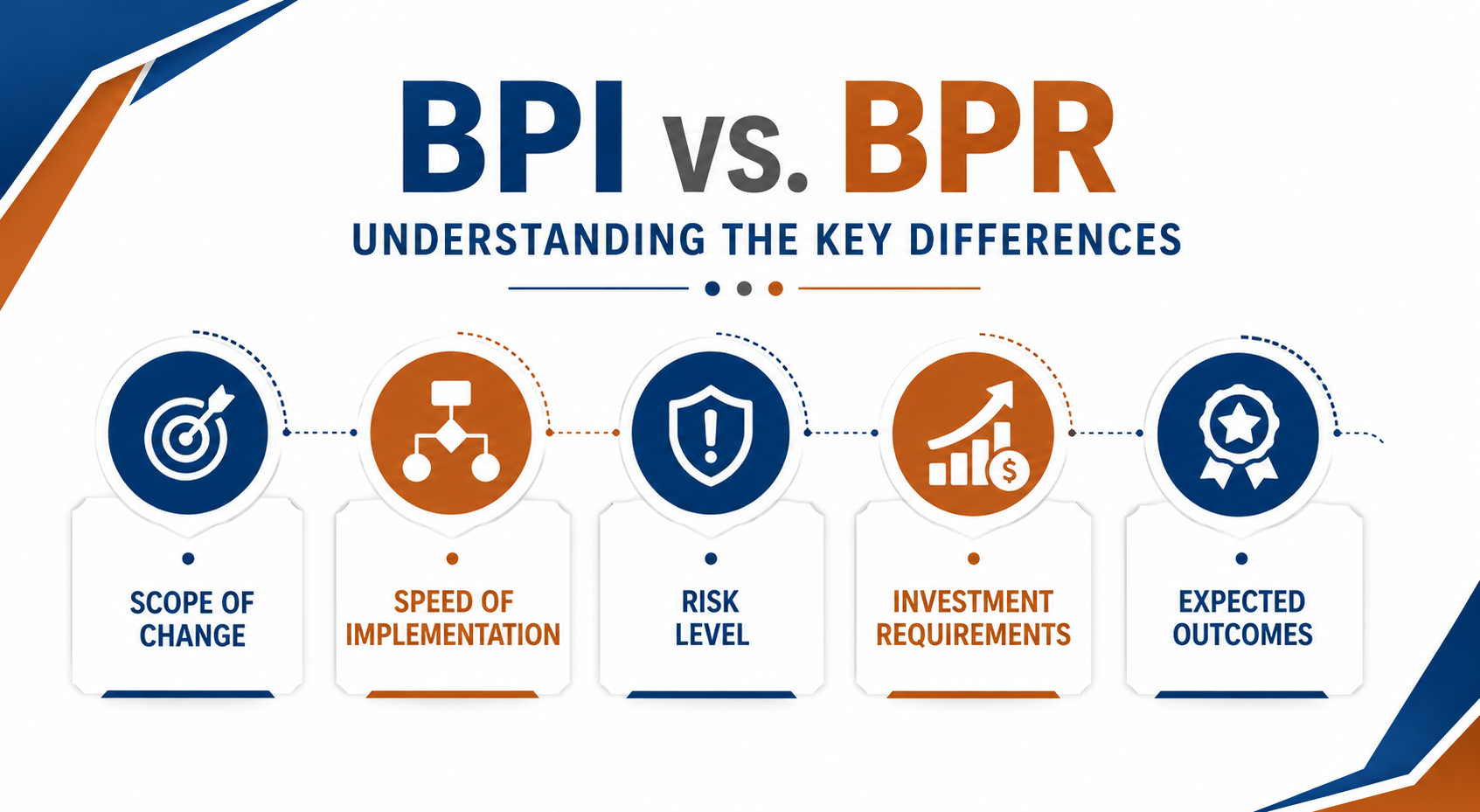
While Business Process Improvement (BPI) and Business Process Reengineering (BPR) both aim to improve business processes, they differ significantly in scope, investment, risk, and expected outcomes. Understanding these differences is critical for leaders responsible for business process management, digital transformation, ERP modernization, and operational improvement initiatives.
At a high level, BPI focuses on refining existing workflows through a continuous improvement process, while BPR uses a more radical approach to process redesign when existing business processes no longer support organizational goals.
The most significant difference between BPI and BPR is the scope of change. Business Process Improvement focuses on optimizing existing workflows by identifying areas for improvement, eliminating redundant steps, and streamlining activities that create delays or inefficiencies. The goal is to improve performance without fundamentally changing how the organization operates.
Business Process Reengineering takes a different approach. Rather than improving the current process, business process re-engineering challenges whether the process should exist in its current form at all. Organizations redesign workflows around future-state business requirements, often creating entirely new ways of working.
BPI is typically implemented in phases over time. Teams use process analysis, performance metrics, and continuous improvement methods to make targeted changes that can be tested and refined with minimal disruption.
A BPR initiative is usually executed as part of a larger transformation effort. Because process redesign often affects systems, governance, reporting structures, and employee responsibilities, implementation requires greater planning, stronger executive sponsorship, and more formal change management.
Business Process Improvement generally carries lower risk because it builds upon existing workflows. The primary risk is that incremental improvements may not address deeper operational challenges if the underlying process is fundamentally flawed.
Business Process Reengineering carries greater risk because multiple parts of the organization may change simultaneously. Business process reengineering efforts frequently affect people, technology, governance, and operating models at the same time, increasing both implementation complexity and organizational disruption.
BPI initiatives typically require smaller investments focused on process optimization, process modeling, and operational improvements. Organizations often use internal teams to identify areas for improvement, reduce cycle times, and strengthen process improvement skills across the business.
BPR often requires more substantial investment because comprehensive process redesign is frequently tied to ERP implementations, process automation initiatives, digital transformation programs, and broader organizational change efforts. Successful business process reengineering may also require external advisory support, employee training, and new governance structures.
Business Process Improvement delivers steady improvements in performance over time. Organizations often use BPI to streamline workflows, improve productivity, enhance customer satisfaction, and support a culture of continuous improvement.
Business Process Reengineering seeks more transformative results. The benefits of business process reengineering can include significant improvements in operational efficiency, customer experience, scalability, and business agility. When executed successfully, a BPR initiative can create a foundation for long-term transformation that incremental improvements alone may not achieve.
Many organizations discover that process challenges are only one part of a broader transformation effort. When process redesign, ERP modernization, automation, and organizational change intersect, leaders need a clear roadmap that aligns technology investments with business objectives.
RubinBrown's Digital Transformation Services help organizations evaluate current-state operations, identify transformation opportunities, and develop practical strategies for technology-enabled business improvement. Schedule an appointment today!
Choosing between Business Process Improvement (BPI) and Business Process Reengineering (BPR) starts with understanding the nature of the challenge. Some organizations need to optimize existing workflows and remove inefficiencies. Others discover that their processes, operating model, or technology landscape no longer support business objectives.
The key distinction is whether the organization is dealing with an execution problem or a design problem. Processes that generally work but suffer from inefficiencies often benefit from targeted improvement efforts. Processes that have become barriers to growth, scalability, or transformation may require a more fundamental redesign.
Business Process Improvement is typically the right approach when the underlying process remains effective, but execution has become inefficient. Employees may encounter delays, redundant activities, inconsistent practices, or workflow bottlenecks, yet the overall process continues to support business objectives.
In these situations, targeted process analysis and optimization can often deliver meaningful improvements in performance without requiring significant organizational change. Organizations can streamline workflows, improve process consistency, reduce cycle times, and strengthen operational efficiency while preserving the core structure of existing business processes.
Business Process Reengineering becomes more appropriate when the process itself is limiting performance. Legacy technology, years of accumulated workarounds, changing customer expectations, and evolving business models can create structural challenges that incremental improvements cannot resolve.
Organizations often encounter this situation during ERP modernization efforts, digital transformation initiatives, mergers and acquisitions, or periods of rapid growth. When existing workflows no longer align with strategic objectives, process redesign may create greater long-term value than continued optimization.
Read Next: How to Build a Data Governance Framework for Your ERP
Read Next: ERP Data Migration vs. Data Integration: Key Differences (And Why You Need Both)
Many organizations view digital transformation as a technology initiative, but technology alone rarely solves process challenges. ERP systems, automation, artificial intelligence, and analytics can improve performance, but their success often depends on the effectiveness of the underlying business processes.
When existing workflows are fundamentally sound, technology can help organizations streamline activities, reduce manual effort, and improve operational efficiency. In these situations, Business Process Improvement is often sufficient to support transformation goals.
However, when outdated processes, legacy systems, or organizational complexity limit performance, technology may expose the need for broader process redesign. In these cases, digital transformation becomes a catalyst for Business Process Reengineering, helping organizations create new operating models rather than simply automate existing workflows.
Read Next: AI Readiness Assessment for Manufacturers: A Practical 5-Step Framework
Every process transformation initiative involves tradeoffs. Business Process Improvement typically offers lower risk and faster implementation, but it may not address deeper operational challenges. Business Process Reengineering can create more transformative outcomes, but it also introduces greater complexity, investment requirements, and organizational disruption.
Before selecting an approach, leaders should understand the risks associated with each path.
The greatest risk associated with BPI is focusing on optimization when the underlying process requires redesign. Organizations can spend significant time improving workflows, reducing cycle times, and eliminating redundant steps without addressing structural constraints that continue to limit performance.
BPI is most effective when the process itself remains sound. When the operating model, technology landscape, or customer requirements have fundamentally changed, incremental improvements may deliver only limited value.
The primary challenge with BPR is execution. Successful business process reengineering efforts require strong governance, executive sponsorship, effective change management, and organizational commitment. Without those elements, even a well-designed future-state process can struggle to gain adoption.
Organizations should also recognize that process redesign often affects multiple areas simultaneously, including technology, reporting, roles, responsibilities, and performance measurement. As a result, implementation complexity is typically much higher than with traditional process improvement initiatives.
The biggest risk is not choosing BPI or BPR. It is choosing the wrong approach to the problem.
Organizations that need process redesign often spend years optimizing workflows that no longer support business objectives. Conversely, some organizations launch large-scale transformation initiatives when targeted improvements could have delivered meaningful results with less cost and disruption. Understanding the nature of the challenge is often the most important step in determining the right path forward.
Read Next: The Ultimate ERP Internal Audit Checklist for CFOs
Choosing between Business Process Improvement and Business Process Reengineering is rarely a technology decision. It is a business decision that should be based on the nature of the problem, the outcomes the organization is trying to achieve, and its ability to absorb change. Before committing to either approach, leaders should evaluate four key areas.
The first question is whether the challenge is rooted in process execution or process design.
If employees are struggling with bottlenecks, manual work, inconsistent execution, or inefficient handoffs, the underlying process may still be sound. In these situations, Business Process Improvement can often deliver meaningful results through targeted optimization efforts.
However, if the process itself no longer supports business objectives, customer expectations, or future growth plans, incremental improvements may not be enough. Organizations facing structural limitations often benefit more from Business Process Reengineering and comprehensive process redesign.
The next consideration is the magnitude of change required.
Organizations pursuing greater efficiency, productivity, or consistency may find that BPI provides a practical path forward. The goal is to improve how work gets done without fundamentally changing how the business operates.
Organizations seeking new capabilities, new operating models, or significant transformation outcomes may require a broader reengineering effort. In these situations, the objective is not simply to improve the process but to rethink how value is created and delivered.
The right strategy can still fail if the organization is not prepared to execute it.
Business Process Improvement typically requires ongoing commitment to continuous improvement, process ownership, and performance measurement. Business Process Reengineering requires a greater level of organizational readiness, including executive sponsorship, effective change management, clear governance, and employee buy-in.
Leaders should assess whether the organization has the capacity, resources, and commitment necessary to support the level of change being considered.
Process decisions should support where the organization is going, not just where it is today.
If current systems, workflows, and operating models can support future business needs, optimization may be sufficient. If growth objectives, customer expectations, digital transformation plans, or technology requirements demand a fundamentally different way of operating, reengineering may provide a stronger long-term foundation.
The most effective transformation initiatives align the scope of change with the scope of the challenge. Organizations that clearly understand their current constraints, future objectives, and readiness for change are better positioned to determine whether refinement or reinvention is the right path forward.
Whether an organization pursues Business Process Improvement or Business Process Reengineering, the success of the initiative often depends less on the methodology itself and more on how the transformation is planned, executed, and sustained. While the scope of change may differ, several practices consistently contribute to stronger outcomes.
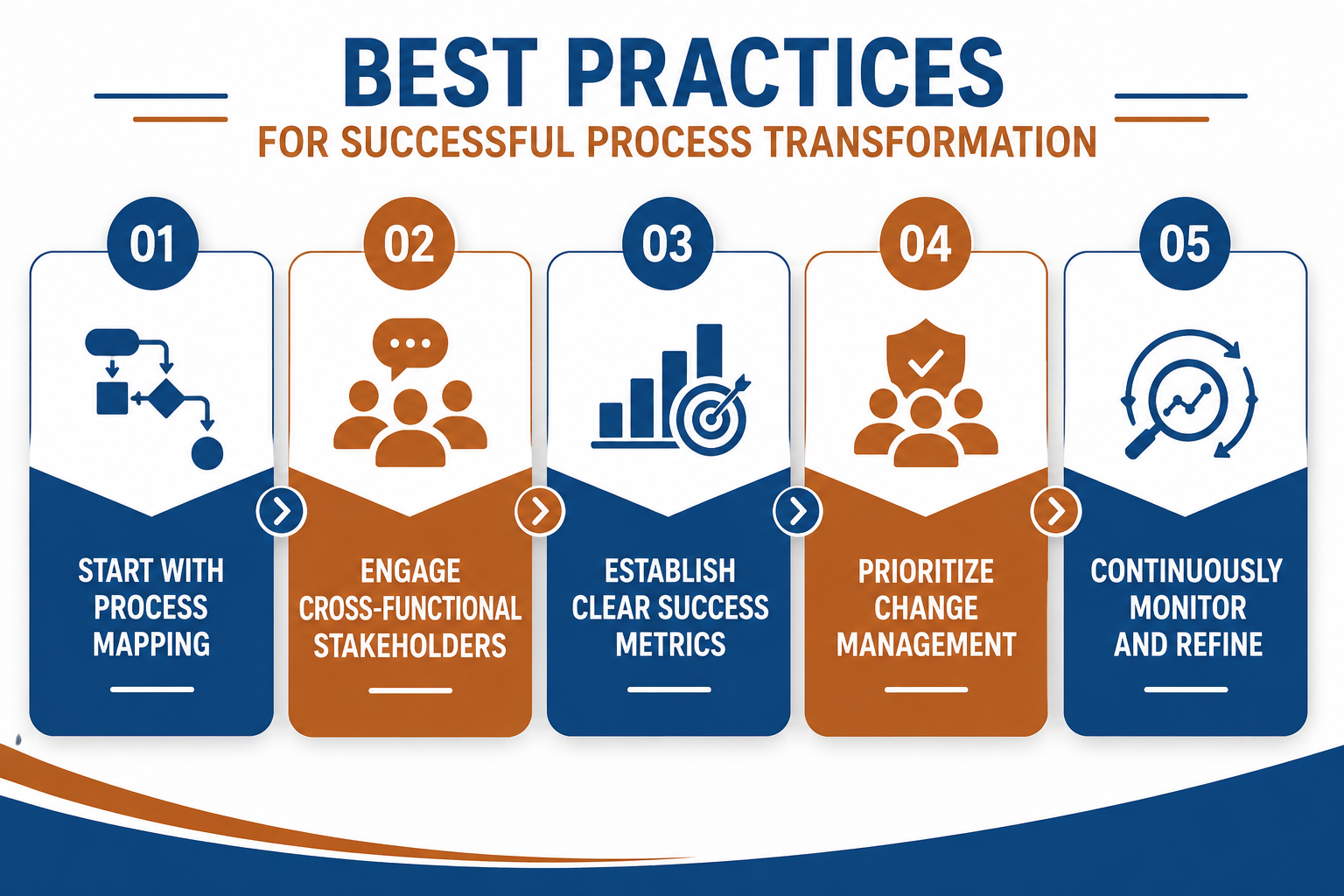
Organizations should begin by documenting how work actually flows through the business before attempting to improve or redesign it. Process mapping helps leaders identify bottlenecks, redundant activities, manual workarounds, and gaps between current-state operations and desired outcomes.
Without a clear understanding of existing workflows, organizations risk optimizing the wrong activities or redesigning processes based on assumptions rather than facts.
Business processes rarely exist within a single department. Operations, finance, IT, customer-facing teams, and process owners often contribute to the same workflow, making cross-functional participation critical to successful transformation.
Engaging stakeholders early helps uncover process dependencies, improve business process management, and build the organizational alignment needed to support long-term adoption.
Transformation initiatives should be measured against business outcomes, not just project milestones. Leaders should define performance metrics that align with the goals of the initiative, whether those goals involve improving productivity, increasing operational efficiency, enhancing customer satisfaction, or strengthening reporting accuracy.
Clear metrics create accountability and help organizations determine whether process changes are delivering the intended value.
Even well-designed processes can fail if employees do not understand, support, or adopt them. Effective change management helps organizations prepare for new ways of working through leadership alignment, communication, training, and stakeholder engagement.
This becomes especially important during Business Process Reengineering initiatives, where changes often affect roles, responsibilities, governance structures, and day-to-day workflows.
Process transformation should not be viewed as a one-time project. Organizations that achieve lasting results continuously monitor performance, evaluate outcomes, and adjust processes as business needs evolve.
Whether the goal is continuous improvement or comprehensive process redesign, ongoing measurement and refinement help ensure that improvements remain aligned with operational objectives and long-term business strategy.
Business Process Improvement and Business Process Reengineering both help organizations improve performance, but they address different challenges. BPI focuses on optimizing existing business processes through incremental improvement, while BPR uses process redesign to support more significant organizational change.
Organizations achieve the best results when they align the scope of change with the nature of the problem. Fundamentally sound processes may benefit from targeted optimization, while outdated workflows, legacy systems, and changing business requirements may require a more comprehensive transformation approach.
As organizations continue investing in ERP modernization, automation, AI, and digital transformation, distinguishing between refinement and reinvention becomes increasingly important. Organizations evaluating process transformation initiatives often benefit from an objective assessment of their processes, technology landscape, and readiness for change. RubinBrown's Business Transformation and ERP Advisory teams help leaders align transformation strategies with operational goals, technology investments, and long-term business outcomes.
The answer depends on the nature of the problem. If existing business processes generally work but need greater efficiency, consistency, or productivity, Business Process Improvement may be sufficient. If workflows, systems, or operating models are preventing the organization from achieving its goals, Business Process Reengineering may be the better approach.
Yes. Many organizations begin with Business Process Reengineering to redesign critical workflows and then use a continuous improvement approach to optimize and refine those processes over time. The two methodologies are not mutually exclusive and often support different stages of transformation.
The benefits of Business Process Reengineering can include improved operational efficiency, reduced cycle times, stronger customer experiences, greater scalability, and the ability to support new business models. However, achieving these outcomes typically requires significant planning, governance, and change management.
No. Some digital transformation initiatives focus on improving existing workflows through automation, analytics, or ERP enhancements. However, when technology investments are intended to support new ways of working, process redesign may be necessary to realize their full value.
The greatest risk is misalignment between the problem and the solution. Organizations sometimes spend years optimizing processes that require redesign, while others pursue large-scale transformation when targeted improvements would have delivered the desired outcome with less cost and disruption.
Change management is critical regardless of the approach selected. Whether pursuing incremental improvements or a larger BPR initiative, employee adoption, leadership alignment, communication, and training play a significant role in long-term success.
Organizations should assess current process performance, business objectives, technology constraints, organizational readiness, and success metrics. A clear understanding of these factors helps leaders determine whether process improvement or business process reengineering is the most appropriate path forward.

Learn 10 signs your business process is inefficient. Discover how broken workflows and inefficient processes may be quietly hurting your business.
The key to achieving a successful technology-enabled business transformation lies in process optimization.

You can use a variety of tools to document your business, including flowcharts, process maps, and text descriptions.