Top 10 Best Manufacturing ERP Systems and Software Solutions for the Manufacturing Industry
Manufacturing success relies on more than just efficient production lines—it demands a fully integrated approach to managing all business operations....
16 min read

Aging infrastructure and rising reliability standards have put utility operations under a microscope. According to industry research, using AI-powered predictive maintenance can reduce equipment failures by 73%
and cut unplanned downtime by 40%. Yet, many organizations still rely on scheduled maintenance that treats every asset the same, regardless of its actual condition.
The real opportunity lies in using the data utilities already collected, including sensor readings, maintenance logs, and operational records, to predict equipment failures before they happen. By applying machine learning and advanced analytics, utilities can move from reactive maintenance to a proactive maintenance strategy that prioritizes reliability, cost control, and regulatory compliance.
This guide covers:
P.S. Utilities looking to improve reliability and reduce maintenance costs need a clear plan for using AI and analytics in their asset management programs. RubinBrown helps organizations assess their readiness for AI and digital transformation by evaluating data, processes, and technology alignment.
Take our AI Readiness Assessment to identify opportunities and risks, supporting utilities as they plan and implement predictive maintenance and other advanced asset management strategies.
| Key Insight | Details |
|---|---|
| What is AI predictive maintenance for utilities? | AI predictive maintenance uses machine learning models and real-time analytics to forecast equipment failures, optimize maintenance schedules, and extend asset life by analyzing sensor data, maintenance logs, and operational records. |
| Top benefits for utilities | Utilities can achieve 30–50% lower emergency maintenance costs, reduce unplanned outages by up to 70%, extend asset lifespan by 5–7 years, and improve regulatory compliance through data-driven reliability. |
| Types of data and analytics used | Predictive maintenance relies on SCADA sensor data (temperature, vibration, oil quality), historical maintenance logs, ERP/EAM records, and unstructured documents like technician notes and inspection images. |
| How predictive differs from preventive/reactive | Predictive maintenance uses real-time data and AI to anticipate failures, while preventive maintenance relies on fixed schedules and reactive maintenance waits for breakdowns, often resulting in higher costs and more downtime. |
| Implementation steps | Start by improving data quality, integrating sensor and maintenance data with ERP/EAM, pilot AI models on critical assets like transformers and feeders, and scale up after validation. |
| Common challenges | Utilities face data silos (e.g., SCADA vs. ERP), integration hurdles with legacy systems, change management for maintenance teams, and the need for high-quality sensor and historical data to train AI models. |
| Role of ERP/asset management systems | Integrating AI insights with ERP/EAM systems creates a single source of truth, streamlines work orders, inventory, and compliance, and enables utilities to act on predictive recommendations efficiently. |
| Future trends | Generative AI, digital twins, and prescriptive analytics will further automate maintenance, enable natural language troubleshooting, and support autonomous operations in utility asset management. |
Utilities operate in a high-stakes environment where every outage, equipment failure, or regulatory penalty has real financial and reputational consequences. Traditional maintenance strategies, like reactive and preventive, often fall short.
For example, reactive maintenance means waiting for a transformer to fail, which can cause a 12-hour outage for thousands of customers and trigger regulatory penalties for exceeding SAIDI/SAIFI targets. Preventive maintenance, such as replacing all substation breakers every three years, can lead to unnecessary part replacements and wasted labor, especially when many of those breakers are still in good condition.
AI-powered predictive maintenance changes this dynamic. By using real-time sensor data, maintenance histories, and analytics, utilities can predict equipment failures before they happen.
For instance, machine learning models can flag a transformer with rising oil temperature and abnormal gas levels, prompting a targeted inspection and repair before a costly outage occurs. This approach helps utilities minimize outages, reduce maintenance costs, and meet regulatory requirements with greater confidence.
Read Next: Asset Management with ERP Systems: The Utility Leader's Guide to Operational Efficiency
Utilities are moving away from one-size-fits-all maintenance schedules and toward a model that uses real-time data and analytics to make precise maintenance decisions. This approach relies on integrating sensor data, maintenance logs, and ERP or enterprise asset management systems to create a complete picture of asset health.
AI models analyze this information to predict failures, recommend maintenance actions, and help utilities prioritize resources. The result is a maintenance strategy that reduces unnecessary work, prevents outages, and supports long-term asset performance.
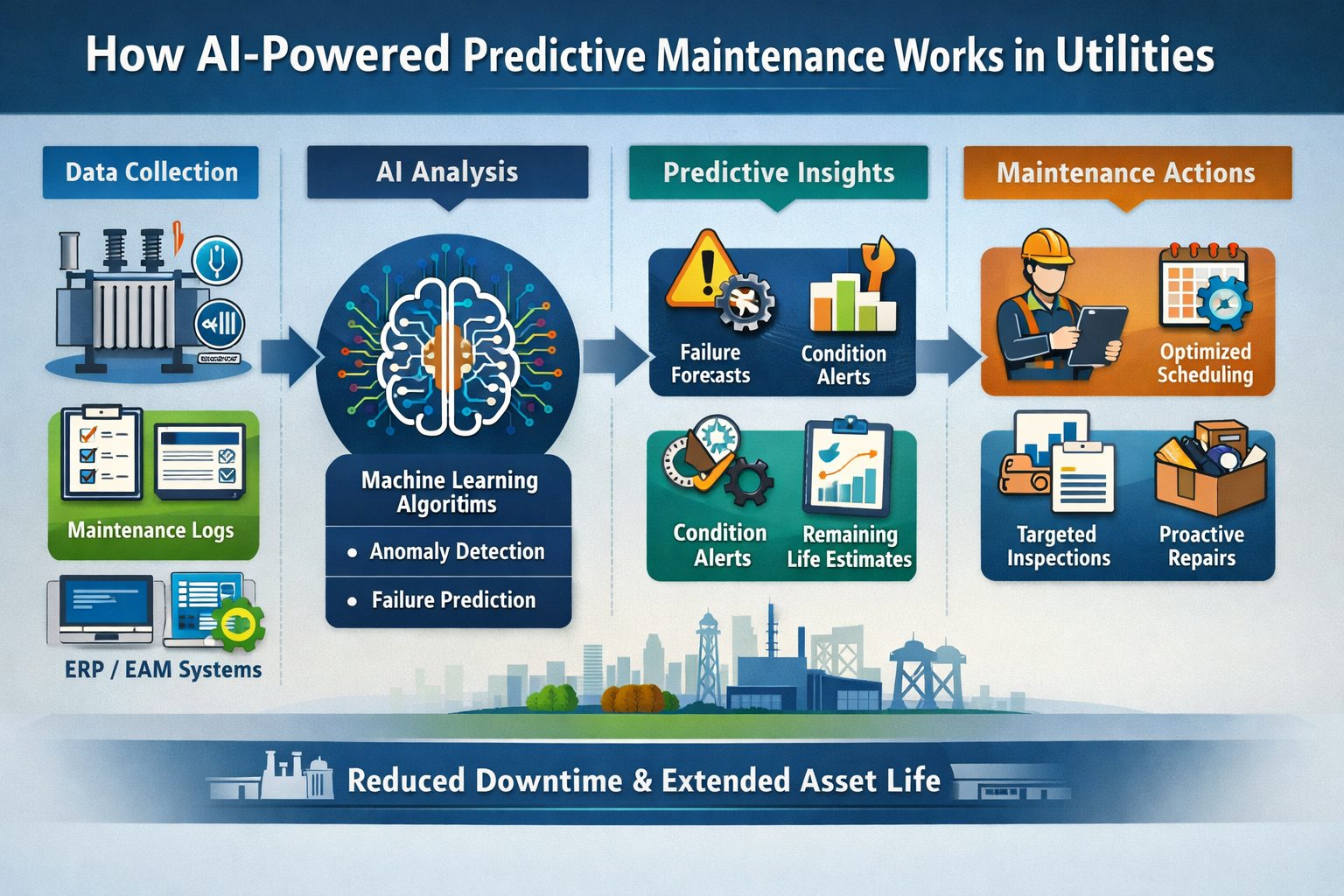
A successful predictive maintenance program starts with collecting and organizing the right data. Utilities use sensors to monitor temperature, vibration, pressure, and electrical load on critical assets like transformers and circuit breakers. These readings are combined with maintenance logs, outage records, and ERP/EAM data to create a detailed history for each asset.
AI models analyze this data to identify patterns that signal equipment failures, while unstructured documents, such as technician notes and inspection images, add context and help explain unusual events. By using both structured and unstructured data, utilities can generate predictive insights that guide maintenance teams and improve reliability.
Machine learning models are the core of predictive maintenance systems. These models use historical maintenance records, real-time sensor data, and advanced analytics to predict when equipment failures are likely to occur. Utilities rely on several types of algorithms and AI tools to support their maintenance strategy:
Predictive maintenance is only valuable if it leads to clear, actionable steps for maintenance teams. AI-powered systems translate predictive insights into specific maintenance recommendations and optimized schedules. Utilities can compare different maintenance approaches and see how AI changes the way work is planned and executed:
| Maintenance Approach | Example in Utilities | How Predictive Maintenance Improves It |
|---|---|---|
| Calendar-Based Maintenance | Inspecting all substation transformers every 6 months, regardless of condition | Predictive analytics use sensor data to identify which transformers show early signs of insulation breakdown, so only those units are scheduled for inspection, reducing unnecessary site visits and maintenance costs. |
| Condition-Based Maintenance | Scheduling breaker maintenance when vibration exceeds a set threshold | Predictive models analyze historical maintenance logs and real-time data to forecast which breakers are likely to fail within 30 days, allowing utilities to group maintenance actions and avoid emergency repairs. |
| Predictive Maintenance | Using machine learning to predict cable faults based on partial discharge data | Utilities can plan cable replacements before failures occur, preventing outages that would otherwise disrupt thousands of customers and avoiding regulatory penalties for reliability violations. |
| Maintenance Scheduling | Assigning crews to inspect all feeders in a region on a fixed schedule | Predictive scheduling tools group work orders by asset risk and location, so crews focus on feeders with the highest probability of failure, reducing travel time and overtime costs. |
| Work Order Management | Manually creating work orders after a failure is reported | Predictive maintenance systems automatically generate work orders when sensor data indicates a high risk of failure, ensuring timely intervention and complete documentation for compliance. |
| Inventory Planning | Stocking spare parts based on historical averages | AI forecasts parts demand based on predictive maintenance schedules and asset criticality, so utilities keep the right parts in stock and avoid delays due to shortages. |
A smooth setup between predictive maintenance systems and ERP or enterprise asset management platforms is essential for utilities. When predictive insights are connected to work order management, inventory planning, and compliance reporting, maintenance teams can act quickly and efficiently.
This integration eliminates data silos, reduces manual data entry, and ensures that every maintenance action is based on the most current information.
Utilities benefit from a single source of truth for asset health, maintenance histories, and operational performance, making it easier to track progress and demonstrate regulatory compliance.
The shift to predictive maintenance changes how maintenance teams work and what skills they need. Utilities must support their workforce through training, clear communication, and new tools that make it easier to interpret predictive insights and act on them. Maintenance teams benefit from:
Measuring the success of predictive maintenance programs requires tracking specific metrics that reflect cost savings, reliability, and operational efficiency. Utilities should focus on:
| Metric/KPI | Example | How to Track/Improve |
|---|---|---|
| Cost Avoidance | $200,000 saved by preventing a transformer failure through early intervention | Compare emergency maintenance costs before and after AI implementation, track savings per asset type |
| Outage Reduction | 40% decrease in feeder outages after implementing predictive analytics | Track outage frequency and duration, benchmark against industry standards |
| Asset Lifespan Extension | Extending transformer life from 20 to 27 years by replacing bushings before failure | Monitor asset retirement ages and maintenance histories, and analyze the impact of predictive interventions |
| Regulatory Compliance | Avoiding $50,000 in penalties by meeting SAIDI/SAIFI targets | Use automated reporting tools integrated with ERP/EAM systems, track compliance by asset and region |
| False Positive Rate | Reducing unnecessary work orders from 15% to 5% by refining model thresholds | Regularly review alert outcomes, adjust model parameters based on technician feedback |
| Workforce Productivity | 20% increase in completed work orders per month after predictive scheduling | Analyze work order completion times, crew utilization rates, and overtime hours |
| Inventory Optimization | Reducing spare parts inventory by 30% while avoiding stockouts | Use AI-driven demand forecasting, track inventory turnover, and part availability |
Read Next:
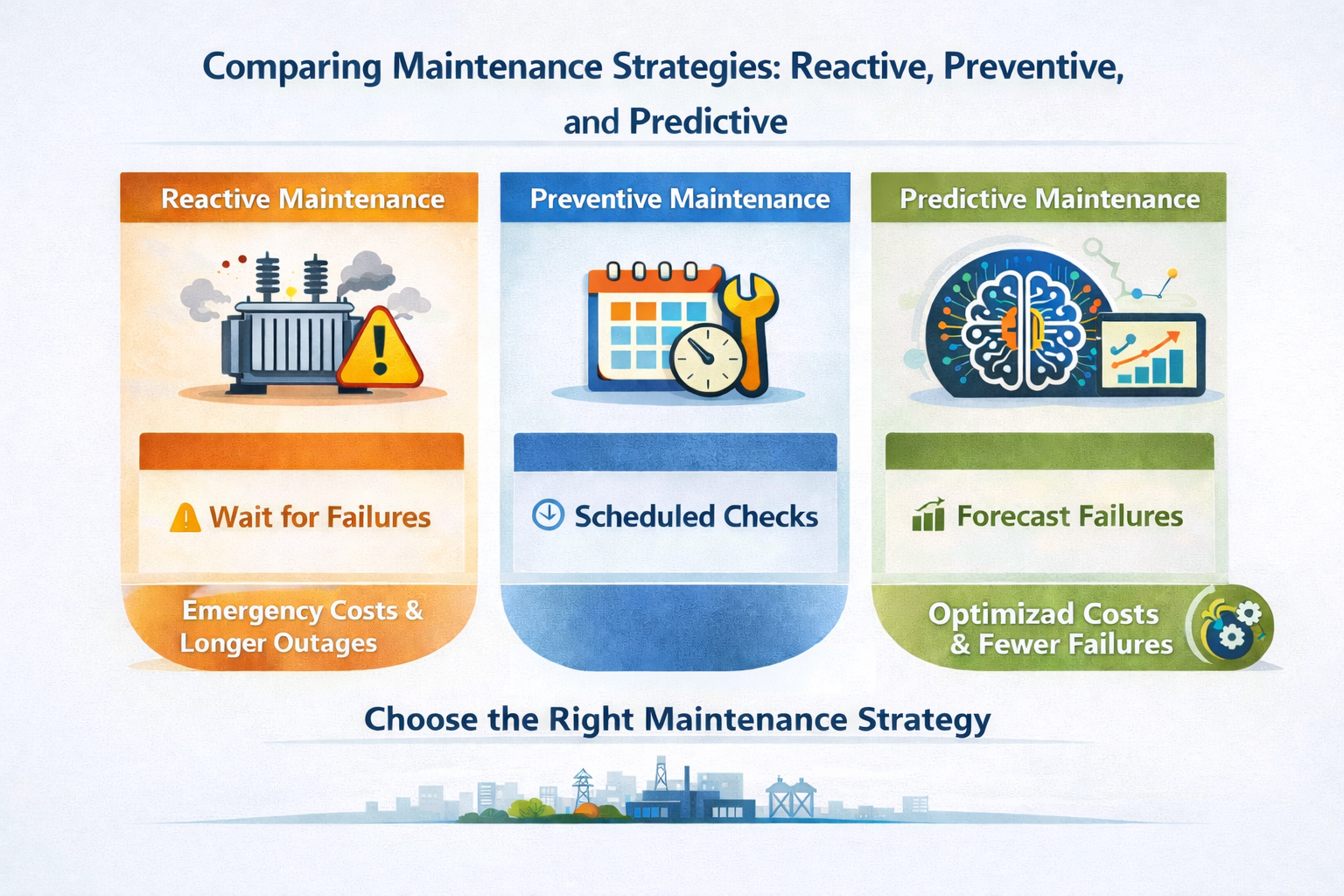
Utilities must choose the right maintenance strategy for each asset and operational goal. Reactive maintenance waits for failures, leading to higher costs and outages. Preventive maintenance uses scheduled inspections and part replacements, which can reduce failures but may result in unnecessary work.
Predictive maintenance uses real-time data, analytics, and AI to forecast failures and recommend targeted interventions. This allows utilities to prioritize maintenance actions, optimize resources, and improve reliability while controlling costs.
| Strategy | Example Scenario | Typical Cost Impact | Operational Impact | When Used |
|---|---|---|---|---|
| Reactive Maintenance | Transformer failure causing a ~12-hour outage affecting ~10,000 customers | Emergency crew overtime, ~$100K lost revenue, ~$50K replacement equipment | Increased outage duration and higher risk of reliability metric penalties (SAIDI/SAIFI) | Older assets without monitoring, remote locations, or low-criticality equipment |
| Preventive Maintenance | Scheduled breaker replacement every 3 years, regardless of condition | ~$10K per breaker replacement; some components replaced before end of life | Reduced failure risk but higher routine maintenance costs | Assets with predictable wear patterns, such as pumps, motors, and mechanical equipment |
| Predictive Maintenance | Analytics detects cable insulation degradation ~1–2 months before failure | ~$5K planned replacement avoids ~$50K+ emergency repair and outage costs | Improved reliability metrics and fewer unplanned outages | Critical feeders, substations, and assets with sensor data or monitoring systems |
Read Next: ERP for Construction Project Managers: Run Smarter Projects With Real-Time Field Data
Launching a predictive maintenance program requires careful planning, collaboration, and a commitment to continuous improvement. Utilities must start by evaluating their data quality, integrating sensor data with maintenance logs and ERP/EAM records, and piloting AI models on critical assets. Change management is essential, as maintenance teams adapt to new workflows and decision-making processes. By following a structured approach, utilities can minimize risk, maximize ROI, and build a maintenance program that supports long-term reliability and cost control.
A strong predictive maintenance program depends on high-quality, accessible data. Utilities often face challenges with fragmented data sources, where sensor readings are stored separately from maintenance histories and asset records. Addressing these silos is essential for building accurate AI models.
For example, temperature and vibration data from transformer sensors must be linked to maintenance logs in the ERP system, so that AI models can learn which patterns lead to failures. Data cleansing, standardization, and integration with legacy systems such as SCADA, ERP, and EAM platforms are critical first steps.
Utilities should prioritize investments in sensor upgrades, data validation processes, and secure data pipelines to ensure that predictive analytics are based on reliable information.
Piloting predictive maintenance programs allows utilities to test AI models, validate predictions, and build internal expertise before scaling up. This phase is crucial for refining algorithms, demonstrating value, and ensuring that maintenance teams are comfortable with new tools and workflows.
Change management is a critical part of implementing predictive maintenance. Maintenance teams need support as they learn new tools, adapt to data-driven decision-making, and develop new skills. Utilities should invest in training, clear communication, and ongoing feedback to ensure a smooth transition.
For example, utilities can hold regular workshops to review predictive maintenance results, provide hands-on training for using AI dashboards, and create feedback channels for reporting issues with AI-generated recommendations. Engaging stakeholders early, addressing concerns, and celebrating quick wins help build momentum and foster a culture of continuous improvement.
Predictive maintenance is evolving rapidly, with new technologies and methods changing how utilities manage assets and plan maintenance. Staying ahead of these trends helps utilities maintain reliability, control costs, and deliver better service.
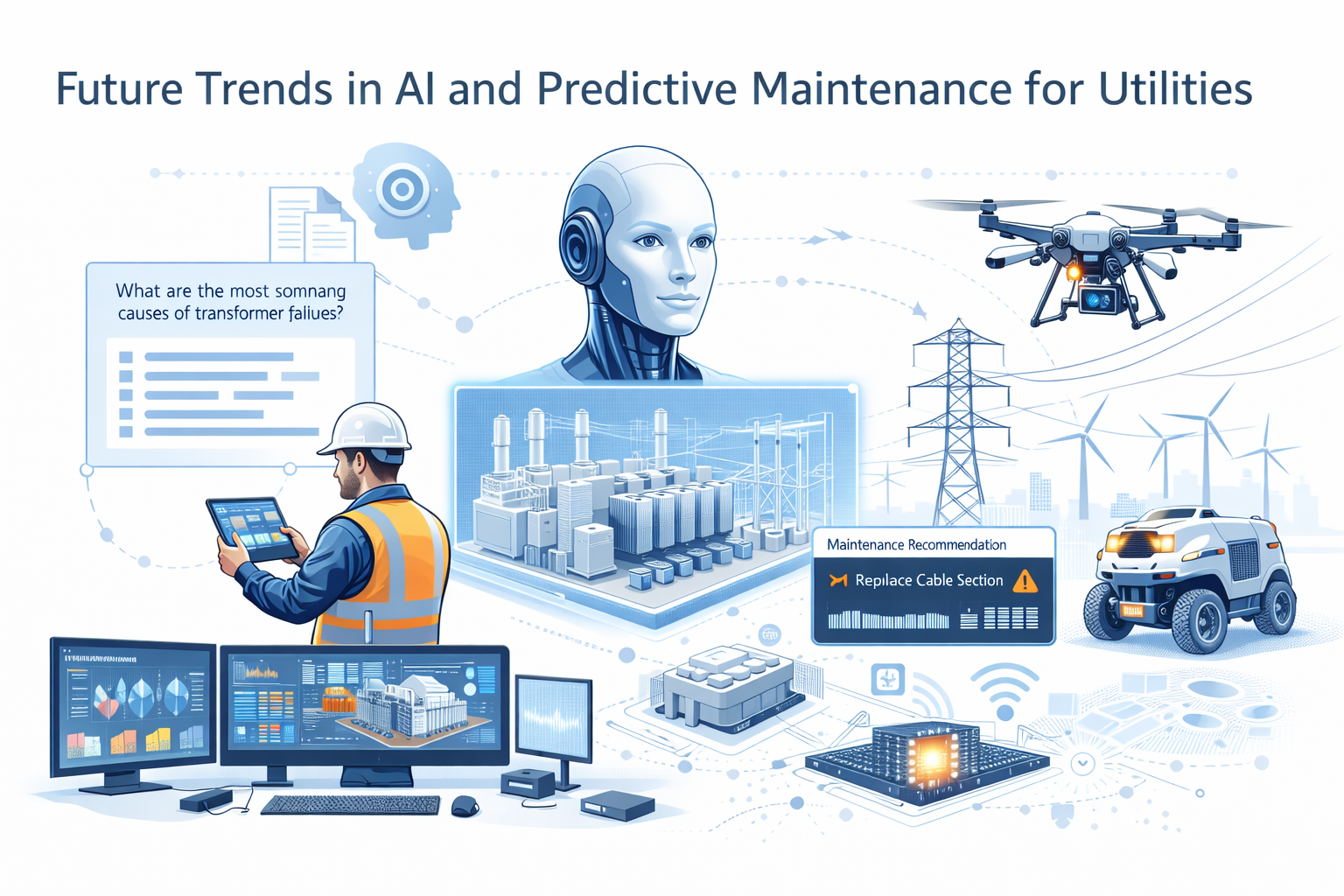
Generative AI and large language models are making it easier for maintenance teams to interact with asset data and predictive insights. Technicians and managers can ask questions in plain language—such as “What are the most common root causes of transformer failures in the past year?”—and receive clear, actionable answers.
Generative AI can also summarize maintenance histories, generate step-by-step repair instructions, and draft work orders based on conversational input. This capability preserves institutional knowledge, accelerates troubleshooting, and reduces the learning curve for new staff.
Utilities are beginning to use digital twins, prescriptive analytics, and autonomous operations to improve maintenance and asset management. These technologies offer new ways to simulate, predict, and automate maintenance actions.
Read Next: AI Readiness Assessment for Manufacturers: A Practical 5-Step Framework
Utilities can take practical steps to begin using AI-driven predictive maintenance and realize its benefits. Each step should be tailored to the organization’s current capabilities, asset base, and operational goals.
After completing these steps, utilities can build on early successes and expand predictive maintenance programs across their operations. This approach supports continuous improvement and helps utilities meet evolving reliability and regulatory standards.
Utilities that want to move from reactive to predictive maintenance need a clear plan, strong data, and a workforce ready to use advanced analytics and AI. By focusing on data quality, piloting AI models, and supporting maintenance teams through change, utilities can reduce outages, lower maintenance costs, and improve reliability. The integration of predictive insights with ERP and asset management systems ensures that every maintenance action is based on real-time data and actual asset condition.
As utilities look to improve reliability and control costs, partnering with experts who understand both technology and operations is essential. Take RubinBrown's AI Readiness Assessment to get a clear, actionable roadmap for reducing costs, improving reliability, and building a future-ready maintenance strategy.
AI predictive maintenance for utilities uses machine learning algorithms and real-time analytics to forecast equipment failures, optimize maintenance schedules, and extend asset life. By analyzing sensor data, maintenance logs, and operational records, AI models can detect patterns that precede failures and recommend targeted interventions, helping utilities move from reactive repairs to proactive, condition-based maintenance strategies.
Predictive maintenance reduces outages by continuously monitoring asset health and identifying early warning signs of equipment degradation. AI models analyze real-time sensor data and historical maintenance records to forecast when failures are likely to occur, allowing utilities to schedule repairs before breakdowns happen. This proactive approach minimizes unplanned downtime, improves reliability, and supports regulatory compliance.
Effective AI-driven predictive maintenance relies on a combination of real-time sensor data (such as temperature, vibration, and pressure readings), historical maintenance logs, ERP/EAM records, and unstructured documents like technician notes and inspection images. High-quality, integrated data is essential for training accurate machine learning models and generating actionable insights.
Utilities integrate AI with existing systems by connecting predictive analytics platforms to SCADA, ERP, and enterprise asset management (EAM) systems. This integration enables automated work order generation, real-time inventory updates, and streamlined compliance reporting. By creating a unified source of truth, utilities can ensure that predictive insights are seamlessly embedded into daily operations and decision-making processes.
The biggest challenges in adopting predictive maintenance include data silos, integration with legacy systems, ensuring data quality, managing change within maintenance teams, and selecting AI solutions that can handle diverse asset types and operational requirements. Addressing these challenges requires careful planning, cross-functional collaboration, and ongoing investment in training and technology.
Success in predictive maintenance programs is measured by tracking key metrics such as cost avoidance, reduction in emergency repairs, decrease in unplanned outages, extension of asset lifespan, improvement in regulatory compliance, reduction in false positive alerts, and gains in workforce productivity. Regularly reviewing these metrics helps utilities demonstrate ROI, refine predictive models, and drive continuous improvement.

Manufacturing success relies on more than just efficient production lines—it demands a fully integrated approach to managing all business operations....

The decision to upgrade to a new enterprise resource planning (ERP) system is a pivotal one, but it's important to recognize that real challenges lie...

In today's digital era, Artificial Intelligence (AI) is revolutionizing various industries, and enterprise resource planning (ERP) systems are no...