Infor CloudSuite ERP: Features, Benefits, Pricing & Implementation Guide
Considering Infor CloudSuite ERP? Discover capabilities, industry use cases, and implementation insights from ERP advisors helping businesses...
11 min read

An ERP selection timeline typically spans several months, with four to nine months as a common initial planning range for many mid-sized, complex organizations. The schedule covers requirements gathering, vendor evaluation, demonstrations, due diligence, and final approval. Business complexity, stakeholder availability, and procurement requirements determine how long each phase takes.
Commercial evaluations can also require additional time. According to ERP Research's September 2026 analysis of 40 ERP systems, 23% did not publish starting prices, requiring buyers to request quotes. For CFOs, CIOs, and ERP steering committees, accounting for these dependencies helps establish realistic milestones, allocate internal resources, and avoid delays before implementation begins.
A four-to-nine-month ERP selection timeline is a useful initial planning range for many mid-sized or complex organizations, although actual duration depends on business requirements, operational complexity, and internal decision-making. Smaller businesses with clearly defined needs may complete selection sooner, particularly when evaluation activities overlap. Organizations with multiple entities, specialized workflows, or extensive approval requirements may need longer.
The following ranges provide illustrative planning estimates, not industry averages or guaranteed completion times.
The greatest scheduling challenges often arise before a vendor is selected. For example, a manufacturer may need additional workshops to reconcile production planning requirements across facilities, while a distributor with standardized processes may complete requirements gathering more quickly. Delays can also occur when finance, IT, and operations cannot agree on evaluation priorities or key stakeholders are unavailable for demonstrations.
Organizations should distinguish the ERP selection timeline from the ERP implementation timeline. Selection covers requirements, vendor evaluation, due diligence, and approval. Implementation involves configuring the chosen system, migrating data, integrating applications, testing workflows, and preparing employees for go-live.
Before establishing a target selection date, executives should confirm stakeholder availability, identify activities that depend on earlier decisions, and account for procurement and approval requirements. These factors provide a more reliable basis for scheduling than choosing a deadline before the required work has been assessed.
A realistic ERP selection timeline accounts for the work required at each stage, the people responsible, and the decisions that must be completed before moving forward. Although some activities can overlap, unresolved requirements or delayed approvals can affect the entire schedule.
The following six phases provide a planning framework for organizations evaluating a new ERP system. The durations are illustrative estimates and should be adjusted for business complexity, resource availability, and procurement requirements.
ERP selection begins with defining the business case and establishing who will lead the initiative. Executives should identify the limitations of the current system, agree on desired operational improvements, and determine which departments will participate.
This phase also establishes project governance. The organization should appoint an executive sponsor, assign a selection lead, identify key stakeholders, and confirm how decisions will be made. For example, if a manufacturer wants to improve inventory accuracy and production planning, leadership should agree on those objectives before evaluating software capabilities.
Key milestone: An approved selection charter documenting business objectives, preliminary scope, stakeholder responsibilities, and decision authority.
Potential delay: Unclear executive priorities or competing departmental expectations can prevent the selection team from establishing a workable project plan.
Requirements gathering often demands substantial internal participation. Finance, IT, operations, and other business process owners must document essential workflows and determine what the new ERP software needs to support.
The team should examine existing processes, reporting limitations, integration requirements, and areas where process improvement may be necessary. Requirements should be prioritized based on business impact, distinguishing essential functionality from features that would be useful but are not critical.
Consider a distributor with different inventory procedures across several warehouses. Before evaluating vendors, the organization must determine whether those differences represent legitimate operational requirements or processes that should be standardized.
Key milestone: An approved requirements document and weighted evaluation criteria agreed upon by business and technology stakeholders.
Potential delay: Disagreements about workflows, reporting requirements, or future operating processes can extend workshops and force repeated requirements reviews.
Read More: Industry-Specific ERP Systems vs Generic Solutions: Pros and Cons
Once requirements are established, the selection team can identify ERP vendors capable of supporting the organization's operating needs.
The goal is to develop a manageable shortlist of qualified providers. Evaluation should consider functional fit, industry experience, technology architecture, implementation capabilities, and anticipated costs.
Organizations may also issue a request for proposal (RFP) to obtain comparable information about software functionality, commercial terms, implementation assumptions, and vendor support. Vendors need sufficient time to review the requirements, request clarification, and prepare responses. The selection schedule should account for these activities rather than assuming proposals will be available immediately.
Key milestone: An approved vendor shortlist supported by documented qualifications, finalized RFP requirements where applicable, and initial proposal evaluations if responses have been received.
Potential delay: Incomplete RFP documentation, unclear selection criteria, or inconsistent vendor responses can require additional clarification and evaluation.
Read Next: ERP Software Selection Process: How to Choose the Right System
Vendor demonstrations allow stakeholders to assess how proposed ERP solutions handle the organization's critical business processes.
The selection team should provide each shortlisted vendor with consistent demonstration scenarios based on approved requirements. This allows participants to compare solutions against the same operational needs.
For example, a manufacturer may ask vendors to demonstrate how a customer order moves through inventory allocation, production scheduling, shipment, invoicing, and financial reporting. Business representatives should record their findings using an agreed scoring framework. The evaluation should identify functional gaps, potential customization, integration dependencies, and unresolved questions requiring further investigation.
Scheduling also matters. Key stakeholders must be available to attend demonstrations and review findings promptly.
Key milestone: Completed vendor scorecards and a documented recommendation identifying the strongest candidates.
Potential delay: Unstructured demonstrations, unavailable stakeholders, or unresolved functionality questions may require additional vendor sessions.
Read More: ERP Customization Can Make or Break Your Business—Here’s How to Get It Right
Although preliminary technical and commercial reviews may begin during earlier evaluation phases, due diligence becomes more detailed once the organization identifies a preferred solution. Before approving the investment, leadership should validate the system's capabilities, implementation assumptions, and financial implications.
Due diligence should examine software licensing, implementation services, integration responsibilities, anticipated customization, ongoing support, and total cost of ownership. The organization should also consider vendor references, technical requirements, contractual obligations, and the proposed implementation partner's experience.
For instance, a system may meet most functional requirements but require significant integration work with existing applications. That dependency could increase costs and affect the implementation schedule. Finance, IT, procurement, legal, and operational stakeholders should review these findings before the final recommendation is submitted.
Key milestone: A validated business case and preferred-vendor recommendation supported by technical, commercial, and operational due diligence.
Potential delay: Unresolved contractual terms, incomplete cost estimates, or unverified technical assumptions can extend negotiations and approval preparation.
Read More: ERP Total Cost of Ownership: How to Evaluate TCO & Avoid Budget Surprises
The final phase brings together the evaluation findings and establishes whether the organization is prepared to approve the selected ERP system.
The selection team should present the preferred solution, evaluation results, estimated costs, implementation considerations, and material risks to the appropriate decision-makers. For organizations requiring board approval, meeting schedules and documentation deadlines should be accounted for early. A complete recommendation package helps avoid unnecessary requests for additional analysis.
Before authorizing the investment, executives should confirm that critical requirements are achievable, financial assumptions have been reviewed, and significant risks are understood.
Key milestone: Formal authorization of the preferred ERP solution, approved investment parameters, and next steps for contract execution and implementation planning.
Potential delay: Missing financial information, unresolved executive concerns, or unplanned approval requirements can postpone the final decision.
Read Next: Key ERP Implementation Best Practices Every Business Should Follow
Completed sequentially, the six phases represent approximately 19–38 weeks, or roughly four-and-a-half to nine months. This broadly aligns with the four-to-nine-month planning range for many mid-sized or complex organizations.
Shorter selection processes may be achievable when requirements are straightforward and activities overlap, while more complex evaluations may extend beyond nine months. Regardless of the schedule, organizations should preserve formal decision points for requirements, vendor evaluations, and final investment approval.
The final selection roadmap should identify milestone dates, accountable stakeholders, dependencies, approval requirements, and contingency time for unresolved issues. Executive sponsors should evaluate progress against the evidence needed for each decision, not simply whether individual activities have been completed on schedule.
Several factors determine how long an organization needs to evaluate ERP software and reach a final decision. Three deserve particular attention when planning the selection schedule:
Business and Operational Complexity. Organizations with multiple entities, locations, or specialized workflows often need more time to define requirements and assess software capabilities. Integration needs, reporting structures, and differences in business processes can also extend vendor evaluations.
Stakeholder Availability and Decision-Making. ERP selection requires input from finance, IT, operations, and executive leadership. Competing priorities, such as financial close periods or production demands, can delay workshops and approvals. Reserving stakeholder time and establishing clear decision authority helps maintain progress.
Vendor Responsiveness and Procurement Requirements. Preparing proposals, coordinating demonstrations, completing technical reviews, and negotiating contracts all require time. Organizations should also account for cybersecurity assessments, procurement procedures, and board approvals when applicable.
These variables should inform the initial schedule, particularly the duration of requirements workshops, vendor evaluations, and approval cycles.
An ERP selection timeline should account for the time employees need to gather requirements, evaluate vendors, review proposals, and approve decisions. Finance, IT, and operations must each contribute their expertise to ensure the selected system meets business and technical requirements.
Before starting the evaluation, leadership should assign responsibilities and confirm when each stakeholder group will be needed.
Resource planning should include preparation and follow-up work, not only scheduled meetings. For example, controllers may need time outside vendor demonstrations to validate financial reporting scenarios, while IT staff may need to investigate integration requirements.
Executives should also account for competing responsibilities, particularly financial close periods, production demands, and existing technology projects. Confirming participation early helps prevent scheduling conflicts and delays in evaluation decisions.
External ERP advisors can support coordination and vendor assessments, but internal business leaders should retain ownership of requirements and final selection decisions.
ERP selection delays often result from incomplete requirements, unavailable stakeholders, or decisions that take longer than anticipated. Identifying these risks early helps organizations maintain realistic schedules and avoid repeating evaluation activities. Five common delays deserve attention:
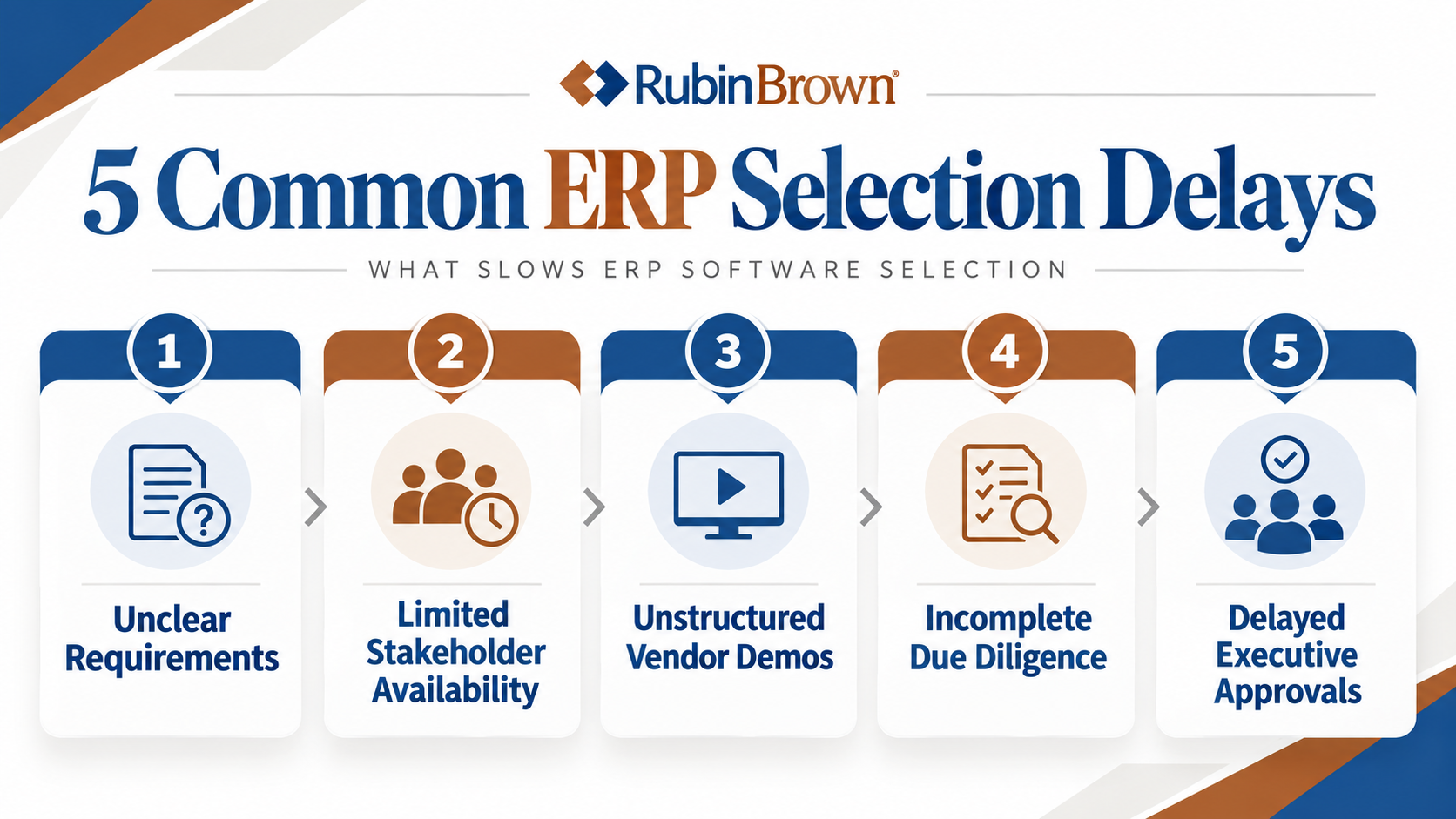
Unresolved business requirements. Conflicting priorities or incomplete specifications can lead to repeated workshops and inconsistent vendor evaluations. Establish approved requirements and selection criteria before scheduling detailed demonstrations.
Limited stakeholder availability. Finance, IT, and operations leaders may struggle to balance selection activities with daily responsibilities. Reserve time for evaluations and approvals in advance, and identify alternate representatives when necessary.
Poorly planned vendor demonstrations. Generic presentations may overlook critical workflows, requiring additional sessions. Provide vendors with consistent, scenario-based requirements and confirm participant availability early.
Incomplete due diligence. Unresolved integration requirements, customization costs, or contractual terms can extend negotiations. Begin technical and commercial reviews before finalizing the preferred vendor.
Delayed executive approvals. Missing documentation or unplanned board review cycles can postpone selection decisions. Confirm approval requirements, decision-makers, and submission deadlines during project mobilization.
For example, a manufacturer may complete vendor demonstrations only to discover that its preferred ERP system requires substantial customization for production scheduling. If this requirement was overlooked during evaluation, the team may need additional demonstrations, revised cost estimates, and further executive review.
To limit these setbacks, the ERP selection lead should maintain a decision register documenting outstanding issues, responsible owners, deadlines, and potential schedule impacts. Critical decisions should be escalated before they affect major milestones.
Read More: Red Flags in ERP Proposals: A Proactive Guide to Successful System Implementations and Integration
Organizations should adjust their ERP selection timeline when changes in requirements, resource availability, or evaluation findings affect the original schedule. Any adjustment should account for its impact on decision quality, costs, and implementation planning.
When to accelerate: A shorter timeline may be appropriate when business requirements are well-defined, stakeholders are available, and vendors can meet evaluation deadlines. Some activities, such as RFP preparation and preliminary technical reviews, may overlap without disrupting the selection process.
When to extend: Additional time may be necessary when critical functionality gaps remain unresolved, cost estimates require further validation, or key decision-makers cannot participate. Organizations facing an expiring software contract should also examine interim arrangements before committing to a replacement system.
The ERP steering committee should approve significant schedule changes based on documented findings, remaining work, and resource requirements. Executives should preserve sufficient time for requirements validation, vendor due diligence, and final approvals to ensure the selected ERP system can support the organization's business needs.
Read Next: How to Avoid ERP Vendor Lock-In and Maintain Long-Term Flexibility
A successful ERP selection schedule balances evaluation rigor with timely decision-making. For CFOs, CIOs, and ERP steering committees, four priorities can help maintain progress without compromising the quality of the final decision:
Establish achievable milestones. Set phase durations based on actual requirements, dependencies, and approval processes.
Confirm evaluation priorities early. Agree on critical business requirements before scheduling detailed vendor demonstrations.
Allocate internal resources. Ensure finance, IT, operations, and executive stakeholders have sufficient time to participate.
Allow time for due diligence. Validate software capabilities, implementation assumptions, and commercial commitments before final approval.
Before beginning vendor evaluations, leadership should establish a selection roadmap with clear responsibilities, decision gates, and realistic deadlines. This provides a practical foundation for managing the selection process and preparing for the implementation ahead.
RubinBrown provides vendor-independent ERP Selection and Advisory Services, drawing on the experience of KnowledgePath Consulting, which joined the firm. Its advisors support business process assessment, requirements development, software evaluation, and vendor selection, helping organizations structure complex decisions around business priorities rather than vendor affiliations.
ERP implementation planning should begin before the final software decision. During vendor evaluations and due diligence, organizations should assess data migration requirements, integration dependencies, internal resource needs, and the proposed implementation partner's responsibilities. These findings help establish a realistic ERP implementation timeline and identify commitments that could affect the overall project budget.
ERP selection criteria should reflect critical business requirements, operational challenges, and long-term objectives. Organizations should prioritize essential functionality, reporting capabilities, integration needs, scalability, and total cost of ownership. Using weighted criteria helps stakeholders compare vendors consistently and select the right ERP system based on documented requirements rather than individual preferences.
An ERP vendor demo should demonstrate how the proposed software handles actual business processes. The selection team should prepare scenarios covering essential workflows, financial reporting, system integrations, and industry-specific requirements. Vendors should demonstrate the same scenarios so stakeholders can evaluate functional fit, identify customization needs, and document unresolved questions before making a recommendation.
The decision depends on whether the current ERP system can meet future business needs at an acceptable cost. Organizations should evaluate existing functionality, support arrangements, integration limitations, and the cost of potential upgrades. If critical requirements cannot be addressed, evaluating a new ERP system may be appropriate. This assessment should occur early enough to avoid spending time on unnecessary vendor evaluations.
An ERP selection checklist should confirm that critical requirements have been validated, vendor evaluations are documented, and significant technical and commercial risks have been reviewed. It should also cover total cost of ownership, implementation assumptions, data quality considerations, contractual obligations, and executive approvals. Completing these checks helps leadership make an informed investment decision and establish realistic expectations for the implementation ahead.

Considering Infor CloudSuite ERP? Discover capabilities, industry use cases, and implementation insights from ERP advisors helping businesses...

Master the ERP software selection process with our 10-step checklist. Discover key criteria, new AI requirements, and how to avoid the 70% failure...

Discover why ERP consulting from an independent ERP consultant reduces risk, improves vendor selection, and ensures ERP implementation success.