How ERP Systems Automate SaaS Revenue Recognition Under ASC 606
Learn how ERP systems automate SaaS revenue recognition, simplify ASC 606 compliance, and improve financial reporting for growing SaaS companies.
12 min read

Growing B2B SaaS businesses typically outgrow QuickBooks when subscription billing, revenue recognition, and financial reporting become too complex to manage efficiently. If your finance team relies on spreadsheets, manual reconciliations, or disconnected systems to close the books and forecast performance, it may be time to evaluate an ERP built to support the next stage of growth.
That transition becomes increasingly important as SaaS finance teams are expected to deliver faster, more accurate insights while managing increasingly complex subscription models. According to The SaaS CFO's 2025 Finance & Ops SaaS Tech Stack Report, 31% of SaaS companies still rely on spreadsheets for revenue recognition, making them the most common revenue recognition solution among the 637 companies surveyed.
For growing SaaS businesses, moving beyond QuickBooks is less about replacing accounting software and more about building finance operations that automate subscription billing, support ASC 606 compliance, improve forecasting, and provide the visibility needed for confident, data-driven decision-making.
Growing SaaS companies often recognize they've outgrown QuickBooks long before they're ready to select an ERP. RubinBrown's ERP Advisory Services help organizations assess ERP readiness, define business requirements, evaluate software options, and reduce implementation risk through independent, vendor-agnostic guidance.
Most SaaS companies do not outgrow QuickBooks because the software stops working. They outgrow it because their finance operations become significantly more complex than traditional accounting software was designed to support.
In the early stages of growth, finance teams typically focus on bookkeeping, basic financial reporting, invoicing, and maintaining accurate financial records. As the business expands, however, finance becomes a strategic function responsible for supporting forecasting, financial planning and analysis (FP&A), investor reporting, capital allocation, and executive decision-making. At the same time, subscription billing models evolve, recurring revenue grows, pricing strategies become more sophisticated, and compliance requirements such as ASC 606 introduce additional complexity.
These changes rarely happen all at once. They accumulate over time, creating manual workarounds that often begin with a few spreadsheets but eventually become essential to day-to-day finance operations. What starts as a practical solution can quickly become a barrier to scalability, reducing visibility into financial performance and increasing the amount of time finance teams spend reconciling data instead of analyzing it.
The table below illustrates how the finance function typically evolves as a SaaS business grows.
The shift from one stage to the next is not simply about handling more transactions. It is about supporting a more sophisticated business model. Finance leaders need accurate, real-time information to evaluate recurring revenue, monitor churn, analyze customer lifetime value, allocate capital effectively, and forecast future performance. Those responsibilities place new demands on finance systems that extend well beyond traditional bookkeeping.
That is why many growing SaaS companies begin evaluating ERP platforms before QuickBooks actually "fails." The goal is not to replace software for the sake of modernization. It is to create finance operations that can scale with the business, automate repetitive processes, improve financial reporting, and provide leadership with reliable information for strategic decisions.
Read Next: ERP Data Migration vs. Data Integration: Key Differences (And Why You Need Both)
Most finance teams don't decide to replace QuickBooks after a single event. The need usually becomes apparent over time as finance processes become more manual, reporting takes longer, and new business requirements are handled outside the accounting system instead of within it.
If several of the situations below describe your finance organization, it may be time to evaluate whether your current systems can continue supporting the business effectively.
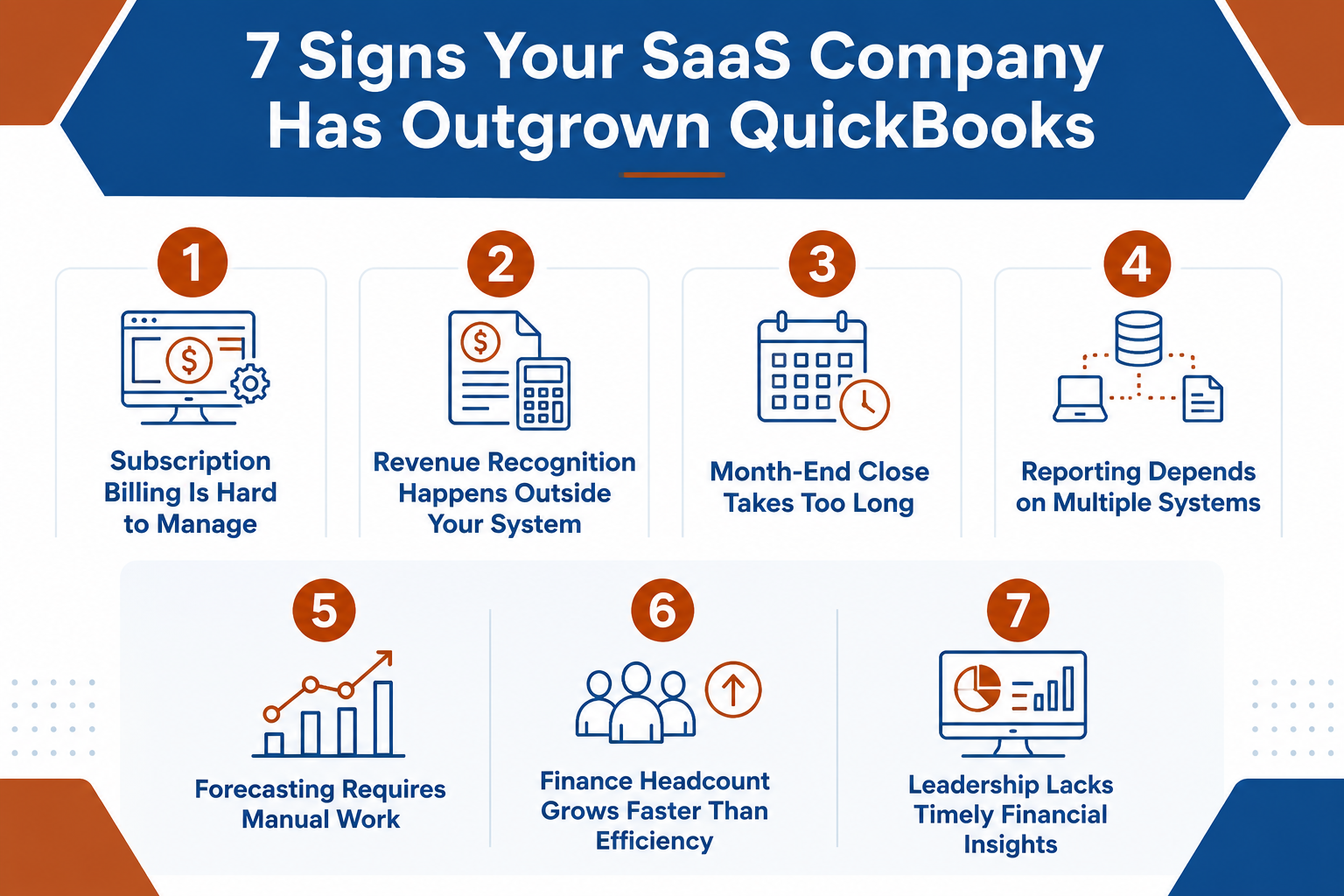
Billing often becomes more complicated as SaaS companies introduce annual contracts, usage-based pricing, customer-specific terms, renewals, mid-contract upgrades, and service credits. Many finance teams initially manage these changes with spreadsheets or manual adjustments, but those workarounds become increasingly difficult to maintain as customer volume grows. Small billing errors can lead to disputes, delayed collections, and additional time spent correcting invoices.
Many growing SaaS companies maintain separate spreadsheets to calculate deferred revenue or track revenue recognition schedules. While that approach may be workable with a small customer base, it creates additional reconciliation work and increases the likelihood of reporting inconsistencies as contracts become more varied. Finance teams also spend more time validating calculations before month-end close and audits.
Closing the books should not become progressively slower simply because the business has grown. If each reporting cycle requires more reconciliations, more spreadsheet reviews, and more manual adjustments than the previous quarter, finance teams lose valuable time that could otherwise be spent on forecasting, budgeting, and business analysis.
Many SaaS organizations eventually find themselves exporting data from QuickBooks, their CRM, billing platform, and spreadsheets before they can produce management reports. Besides consuming valuable time, this process increases the risk of inconsistent numbers when different systems contain conflicting information or are updated on different schedules.
Forecasting becomes less reliable when finance teams manually combine historical financial data with subscription activity, sales pipeline information, and operational assumptions. Every manual update creates another opportunity for errors and makes it harder to provide leadership with timely forecasts as business conditions change.
Hiring additional staff can help absorb short-term workload, but it does not solve inefficient processes. If new team members are primarily responsible for maintaining spreadsheets, reconciling data, or repeating administrative tasks, the finance function may be expanding without becoming more efficient.
Executives need current information to evaluate recurring revenue, cash flow, customer churn, profitability, and other performance indicators. When reports are only available after days of manual preparation, leadership often makes strategic decisions using information that is already out of date.
These challenges rarely occur in isolation. A company managing complex subscription billing is often dealing with slower financial closes, fragmented reporting, and increasing demands on the finance team at the same time. Individually, each issue may seem manageable. Together, they can make it difficult for finance to keep pace with the rest of the business.
Many SaaS companies continue using QuickBooks successfully for years. The deciding factor is whether the system still supports the way the finance team works today. If reporting, billing, and forecasting increasingly depend on spreadsheets and manual intervention, it may be time to reassess the underlying technology.
Finance becomes more complex in a subscription business because customer relationships continue long after the initial sale. A customer may upgrade plans, add users, renew a contract, purchase additional services, or reduce their subscription over time. Each of those changes affects billing, revenue recognition, forecasting, and financial reporting, requiring finance teams to manage an ongoing stream of financial events rather than a single transaction.
As the business grows, leadership also expects finance to answer more sophisticated questions. How much recurring revenue is expected next quarter? Which customer segments are expanding? How much revenue is tied to upcoming renewals? Which pricing models are the most profitable? Answering those questions requires finance teams to combine information from accounting, billing, CRM, and operational systems. When those systems are disconnected, reporting takes longer, manual reconciliation increases, and confidence in the numbers begins to decline.
A finance process that works well for a few hundred customers often becomes difficult to manage as the customer base expands. Invoice adjustments become more frequent, deferred revenue schedules grow longer, and month-end reporting requires additional review. Many finance teams respond by building spreadsheet trackers or creating manual processes that solve immediate problems but add complexity over time.
As SaaS companies mature, finance teams are expected to report on more than revenue and expenses. Leadership also relies on SaaS-specific metrics to evaluate growth, customer behavior, and long-term financial performance. These metrics commonly include:
Annual Recurring Revenue (ARR)
Monthly Recurring Revenue (MRR)
Customer Churn
Customer Lifetime Value (CLV)
Customer Acquisition Cost (CAC)
Net Revenue Retention (NRR)
Gross Revenue Retention (GRR)
Cash Flow Forecasts
Budget-to-Actual Performance
Profitability by Product, Customer, or Subscription Tier
Maintaining these metrics becomes increasingly difficult when financial data is spread across accounting software, CRM platforms, billing applications, and spreadsheets. Finance teams often spend significant time exporting data, validating reports, and reconciling differences before they can begin analyzing business performance. As reporting requirements expand, that manual effort leaves less time for forecasting, pricing analysis, capital planning, and the strategic work finance leaders are increasingly expected to provide.
Read More: How to Build a Data Governance Framework for Your ERP
Many SaaS companies can manage revenue recognition manually during the early stages of growth. As customer contracts become more varied, those manual processes become increasingly difficult to maintain. Annual subscriptions, multi-year agreements, implementation services, customer upgrades, renewals, discounts, and contract modifications all influence how and when revenue is recognized.
Under ASC 606, Revenue from Contracts with Customers, organizations are expected to recognize revenue in a way that reflects the transfer of promised goods or services to customers. While the accounting guidance is well established, applying it consistently across hundreds or thousands of subscription contracts becomes considerably more challenging as a business grows. Finance teams must account for contract modifications, allocate transaction prices, and maintain accurate revenue schedules while continuing to meet monthly reporting deadlines.
Manual revenue recognition often begins with a spreadsheet created to solve a specific problem. Over time, additional contract types, pricing models, and customer scenarios introduce new calculations, exceptions, and review steps. Before long, spreadsheets become an essential part of the month-end close. Finance teams commonly encounter challenges such as:
Maintaining separate revenue schedules for different contract structures
Updating revenue recognition after renewals, upgrades, or contract amendments
Reconciling deferred revenue balances during month-end close
Tracking performance obligations across bundled products and services
Preparing documentation to support audits and financial reviews
Each additional spreadsheet, reconciliation, or manual adjustment increases the amount of time required to complete the close while making it more difficult to ensure consistency across reporting periods.
Revenue recognition does not happen in isolation. Contract terms originate in sales, invoices are generated through billing systems, customer changes are managed by operations or customer success teams, and the resulting financial information is used for reporting and forecasting. When those systems are disconnected, finance teams often spend significant time validating data before they can complete revenue recognition activities.
An ERP helps bring those processes together by connecting contract management, billing, and financial reporting within a single operating environment. Rather than maintaining separate revenue schedules across multiple spreadsheets, finance teams can apply consistent business rules, reduce manual reconciliation, and improve the reliability of financial reporting as contract volume increases.
Organizations evaluating ERP solutions should consider how each platform supports subscription billing, contract modifications, deferred revenue, and ASC 606 workflows alongside broader financial reporting requirements. These capabilities become increasingly important as pricing models evolve and finance operations continue to expand.
Read Next: The Ultimate ERP Internal Audit Checklist for CFOs
Selecting an ERP is about more than replacing accounting software. The right platform should reduce manual work, improve financial visibility, and support the way a subscription-based business operates. That means looking beyond standard accounting functionality and evaluating how each system manages recurring revenue, financial reporting, forecasting, and operational processes that become more demanding as the company grows.
Not every organization will need the same capabilities on day one. However, finance leaders should understand which functions will have the greatest impact on efficiency, reporting accuracy, and long-term scalability before beginning the ERP selection process.
ERP evaluations often begin with product demonstrations and feature comparisons. A more effective approach is to start by documenting how the finance organization operates today and where existing processes create unnecessary effort.
Questions worth asking include:
Which finance processes depend on spreadsheets or manual reconciliation?
Where do reporting delays occur during the month-end close?
Which financial reports require information from multiple systems?
What SaaS metrics are difficult to produce consistently?
Which processes consume the most time for the finance team?
How might finance requirements change over the next three to five years?
The answers help establish business requirements before software evaluations begin. That foundation makes it easier to compare ERP platforms against operational needs rather than selecting a solution based primarily on product features.
Read More: ERP Data Migration vs. Data Integration: Key Differences (And Why You Need Both)
Moving beyond QuickBooks should begin with understanding how your finance organization operates today, not by comparing ERP platforms. The businesses that experience the smoothest transitions typically know which processes consume the most time, where reporting slows down, and which workflows depend on spreadsheets before they start evaluating software. That preparation gives finance leaders a clearer picture of what the business actually needs instead of what a product demonstration promises.
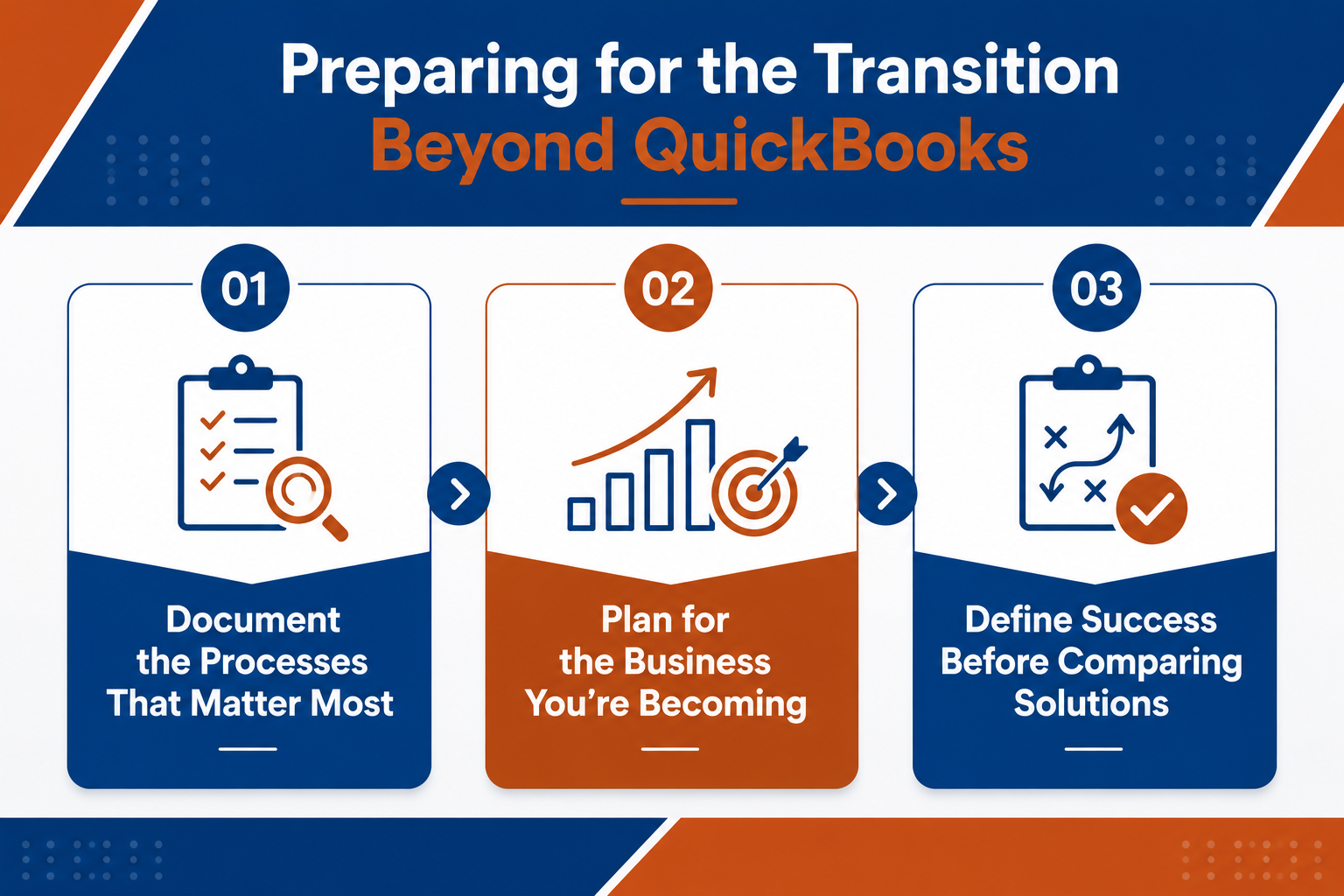
Finance teams often discover that the biggest challenges are not isolated to accounting. Subscription billing, revenue recognition, forecasting, management reporting, and month-end close activities frequently involve information from multiple departments and systems. Mapping those processes before an ERP evaluation helps identify where manual work occurs, where data breaks down, and which improvements will have the greatest operational impact.
An ERP is expected to support the organization for years, not just solve today's reporting challenges. A finance system that works well with one pricing model or a single legal entity may struggle as the business expands through acquisitions, new subscription offerings, or international operations. Evaluating future requirements alongside current needs helps finance leaders select a solution that can support the company's next stage of growth.
Software demonstrations are useful once the business has established its priorities. Finance leaders should first agree on what success looks like, whether that's a faster month-end close, more reliable forecasting, improved visibility into recurring revenue, or fewer manual reconciliations. Those objectives create a practical framework for evaluating ERP platforms and keep the conversation focused on business outcomes rather than feature lists.
For organizations beginning that evaluation, an independent assessment can help establish business requirements before software selection begins. RubinBrown's ERP Advisory Services work with organizations to assess ERP readiness, document business and reporting requirements, evaluate software options, and reduce implementation risk through vendor-independent guidance. This approach helps ensure technology decisions align with long-term operational goals rather than short-term feature comparisons.
Read Next: The Ultimate ERP Internal Audit Checklist for CFOs
QuickBooks supports many SaaS companies during their early years, but finance requirements change as the business grows. Subscription billing becomes more sophisticated, reporting expectations increase, and recurring revenue introduces new operational demands that often extend beyond the capabilities of traditional accounting software.
Understanding those changes before evaluating ERP platforms helps finance leaders make decisions based on business requirements rather than software features. For organizations preparing for that transition, RubinBrown's ERP Advisory Services provide independent guidance to assess ERP readiness, define business requirements, evaluate software options, and reduce implementation risk.
If your finance team is spending more time maintaining spreadsheets than delivering insights, it may be time to determine whether your current systems are ready for the next stage of growth.
There is no single revenue or employee threshold that applies to every organization. Many growing B2B SaaS companies begin evaluating an ERP when finance operations become increasingly manual, reporting takes longer to complete, or subscription billing and revenue recognition require extensive spreadsheet support. If your finance team spends more time maintaining processes than supporting strategic planning, it may be time to assess whether your current systems can support the next stage of SaaS growth.
The right ERP should support the way your business operates rather than simply replacing accounting software. Finance leaders often prioritize subscription billing, revenue recognition, financial reporting, financial planning and analysis (FP&A), workflow automation, and real-time dashboards. As SaaS companies grow, these capabilities help streamline finance operations, reduce repetitive tasks, and provide the visibility needed to make better business decisions.
An ERP gives finance teams access to more consistent financial data by bringing billing, accounting, and operational information together in one system. That allows SaaS FP&A teams to forecast recurring revenue, monitor KPIs, evaluate different pricing scenarios, and support strategic planning without relying on disconnected spreadsheets. For many organizations, better visibility also improves collaboration between finance, marketing, sales, and executive leadership.
Yes. Investors and lenders often expect timely financial reporting, reliable forecasts, and consistent financial controls. An ERP can help finance departments produce more accurate reporting, improve visibility into revenue streams, and strengthen governance as the business grows. While an ERP does not guarantee a return on investment or improve fundraising outcomes, it can provide the financial foundation that supports due diligence and more informed discussions with investors.
Read More: Financial Due Diligence for IT Systems: Uncover Hidden Risks Before You Acquire
Preparation should begin long before software demonstrations. CFOs and finance leaders should document existing finance processes, identify repetitive or time-consuming workflows, evaluate reporting requirements, and understand how financial information moves across day-to-day operations. Taking these steps proactively helps organizations define clear business requirements, compare solutions more effectively, and build a scalable finance function that can support future growth.

Learn how ERP systems automate SaaS revenue recognition, simplify ASC 606 compliance, and improve financial reporting for growing SaaS companies.

Generative AI is changing ERP reporting with natural language queries. Explore practical AI in ERP use cases and how they improve business reporting.

Learn how ERP for field service management helps utility companies improve dispatch, technician productivity, real-time visibility, and service...