6 min read
What Exactly is Digital Transformation?
…and does it really apply to me? Organizations often find themselves in the position of replacing or upgrading their Enterprise Resource...
11 min read

Business transformation requires significant investment, but investment alone does not guarantee results. A Gartner research shows that only 48% of digital transformation initiatives meet or exceed their business outcome targets. The gap often comes down to execution.
Organizations succeed when they connect transformation goals to operational KPIs that track real business outcomes. Clear KPIs translate strategy into measurable targets, guide day-to-day decisions, and highlight performance gaps early.
Organizations that link transformation to real-world KPIs move beyond aspiration and deliver measurable change.
This guide covers:
P.S. Transformation is only as strong as the system you use to measure it. RubinBrown’s approach is built on decades of experience guiding organizations through complex change, with a focus on aligning KPIs to real business strategy and outcomes. Our team works alongside yours to clarify what matters, streamline reporting, and ensure every metric supports your most important goals. With the right advisory partner, you gain the structure and insight to move from data to action—without losing momentum or clarity. Start with our ERP Advisory Service to put a proven measurement framework in place and accelerate your transformation.
| Key Insight | Specifics & Action Steps |
|---|---|
| Transformation KPIs are strategic levers | Use KPIs to steer decisions, allocate resources, and track real business impact, not just report activity. |
| Five core KPI dimensions matter most | Focus on strategic alignment, financial impact, operational efficiency, customer/market outcomes, and organizational health for a balanced scorecard. |
| Scorecard design is a stepwise process | Start with vision, select actionable KPIs, align stakeholders, and set adaptive review rhythms for ongoing relevance. |
| Avoid common KPI mistakes | Don’t chase vanity metrics, overload dashboards, or ignore lagging/leading indicators—clarity and ownership are essential. |
| Real-time analytics drive transformation | Leverage automation and real-time data to make KPI tracking dynamic, actionable, and cross-functional. |
| Behavioral indicators (KBIs) add depth | Track engagement, innovation, and openness to change alongside traditional KPIs for early signals of transformation health. |
| Adaptive KPI systems outperform static ones | Regularly review, evolve, and sunset KPIs to keep your measurement system aligned with transformation goals. |
| Expert guidance accelerates results | A well-built transformation scorecard, supported by advisory expertise, maximizes ROI and reduces risk. |
Transformation KPIs are the backbone of any serious change initiative. They connect your strategy to measurable results and keep teams focused on what drives value. When you move away from legacy metrics and focus on KPIs that reflect your transformation goals, you create a management system that supports real progress. These KPIs should be clear, actionable, and flexible enough to adapt as your business evolves.
Each set of KPIs offers a unique strategic valuation. Traditional metrics like productivity rates, cost efficiency, or annual engagement scores reflect stability and incremental improvement. Transformation, by contrast, demands KPIs that are forward-looking, project-driven, and tightly linked to strategic objectives.
A strategic KPI in this context is one that directly influences decision-making, signals progress toward transformation goals, and prompts timely course corrections. These KPIs are actionable, outcome-focused, and designed to cut through noise, ensuring that every initiative can be traced back to a business objective or measurable benefit. When selected thoughtfully, they become the north star for teams, guiding behavior and resource allocation.
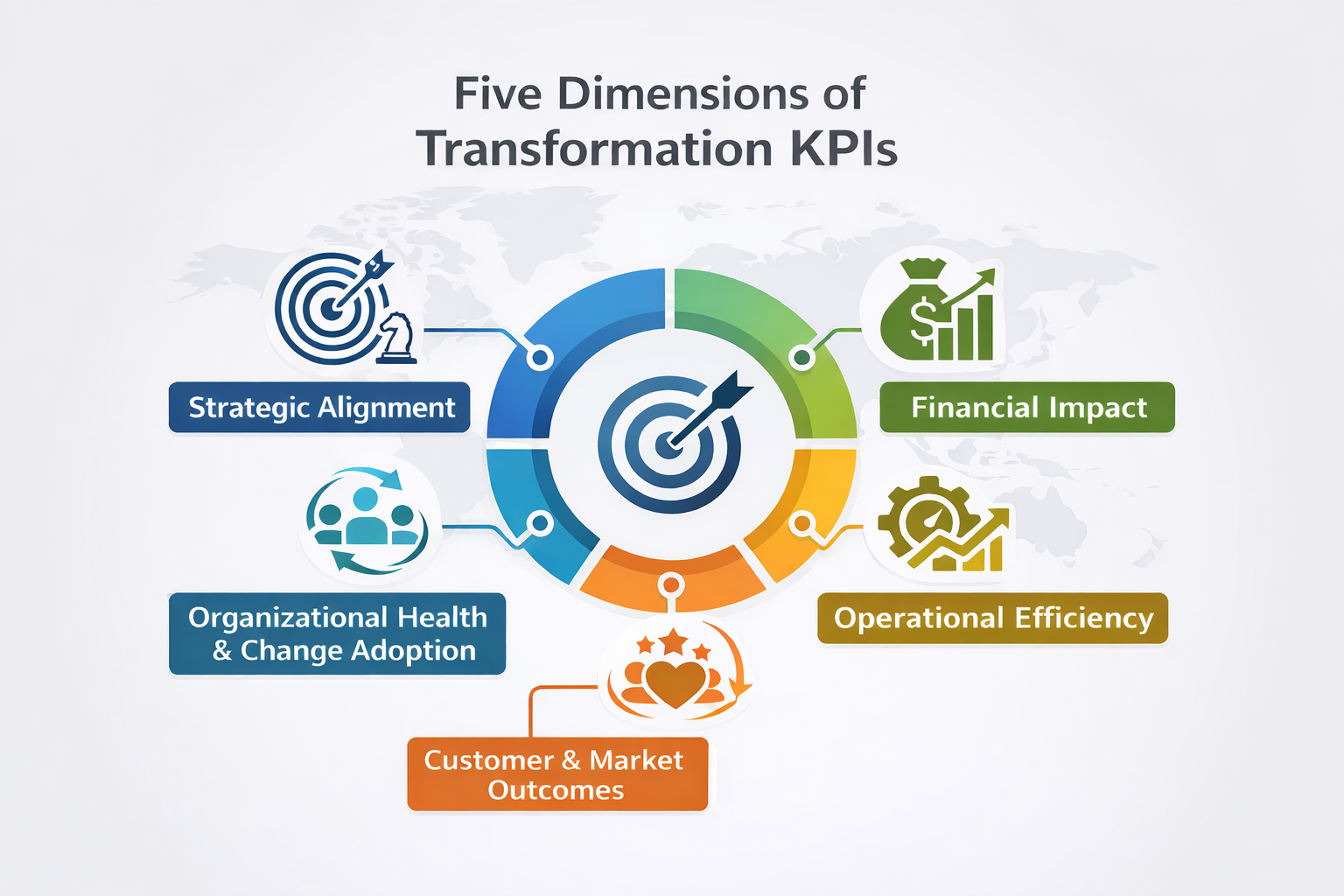
A robust transformation scorecard covers five essential dimensions, each providing a unique lens on progress and risk. The table below details what each dimension covers, why it matters, and how to measure it, with specific KPI examples for practical application.
| Dimension | What It Covers | Why It Matters | How to Measure & Example KPIs |
|---|---|---|---|
| Strategic Alignment | Tracks how well transformation initiatives map to strategic goals and business objectives. | Ensures every project drives the intended business impact and prevents resource drift. | Strategic Initiative Progress, Business Objective Achievement Rate, Strategic Resource Allocation Ratio |
| Financial Impact | Measures the direct and indirect financial outcomes of transformation, including ROI and cost savings. | Quantifies value creation, supports investment decisions, and demonstrates business benefits. | ROI, Cost Savings, Revenue Growth from New Initiatives, LTV:CAC Ratio |
| Operational Efficiency | Assesses improvements in process speed, automation, and resource utilization. | Drives sustainable growth by reducing waste and increasing throughput. | Cycle Time, Throughput Rate, Automation Rate, Resource Utilization Rate |
| Customer & Market Outcomes | Evaluates how transformation affects customer loyalty, market share, and satisfaction. | Links transformation to external business impact and competitive advantage. | Net Promoter Score (NPS), Customer Churn Rate, Market Share, Time to Market |
| Organizational Health & Change Adoption | Monitors employee engagement, adoption of new tools, and cultural readiness for change. | Identifies early signs of resistance or momentum, supporting long-term transformation success. | Employee Engagement Score, New Process Adoption Rate, Training Effectiveness, Change Communication Effectiveness |
Read Next: 10 Signs Your Business Processes Are Broken and Slowing You Down
Designing a transformation KPI scorecard is a deliberate process that moves from vision to execution. Each step builds on the last, ensuring that measurement is both meaningful and manageable.
Read Next: ERP for Construction Project Managers: Run Smarter Projects With Real-Time Field Data
Even with the best intentions, organizations often stumble when it comes to KPI design and execution during transformation. The pressure to show progress can lead to shortcuts, while the complexity of change can overwhelm even experienced teams. By proactively addressing these challenges, decision makers can ensure that their measurement approach reflects clarity and momentum, rather than confusion or frustration.
Read Next: ERP Controls for SOX Compliance: A CFO’s Guide to Audit-Ready Systems
The pace of transformation requires a strategic measurement system that adapts as the business evolves. Real-time analytics and automation enable leaders to monitor KPIs continuously, spot deviations early, and respond with agility.
By integrating KPI dashboards into daily management routines, organizations can shift from reactive to proactive decision-making. Adaptive review rhythms, such as weekly stand-ups for high-priority initiatives and quarterly deep-dives for strategic alignment, ensure that measurement remains relevant and actionable. Cross-functional KPIs break down silos, while incentive alignment ties rewards to real-time progress and impact.
This dynamic approach transforms KPI tracking from a static compliance task into a source of competitive advantage, empowering leaders to drive transformation with confidence.
Read Next: Best ERP Solution Providers: Compare Top ERP Vendors & Systems
KPIs only drive transformation when they are tightly linked to your strategy and embraced by your teams. Every metric should reinforce a business priority and be relevant to those responsible for results. This alignment does not happen by accident. Leaders must translate high-level goals into specific, actionable KPIs, involve stakeholders in the process, and review metrics regularly. When KPIs are connected to both strategy and daily operations, they become tools for focus, accountability, and sustained progress.
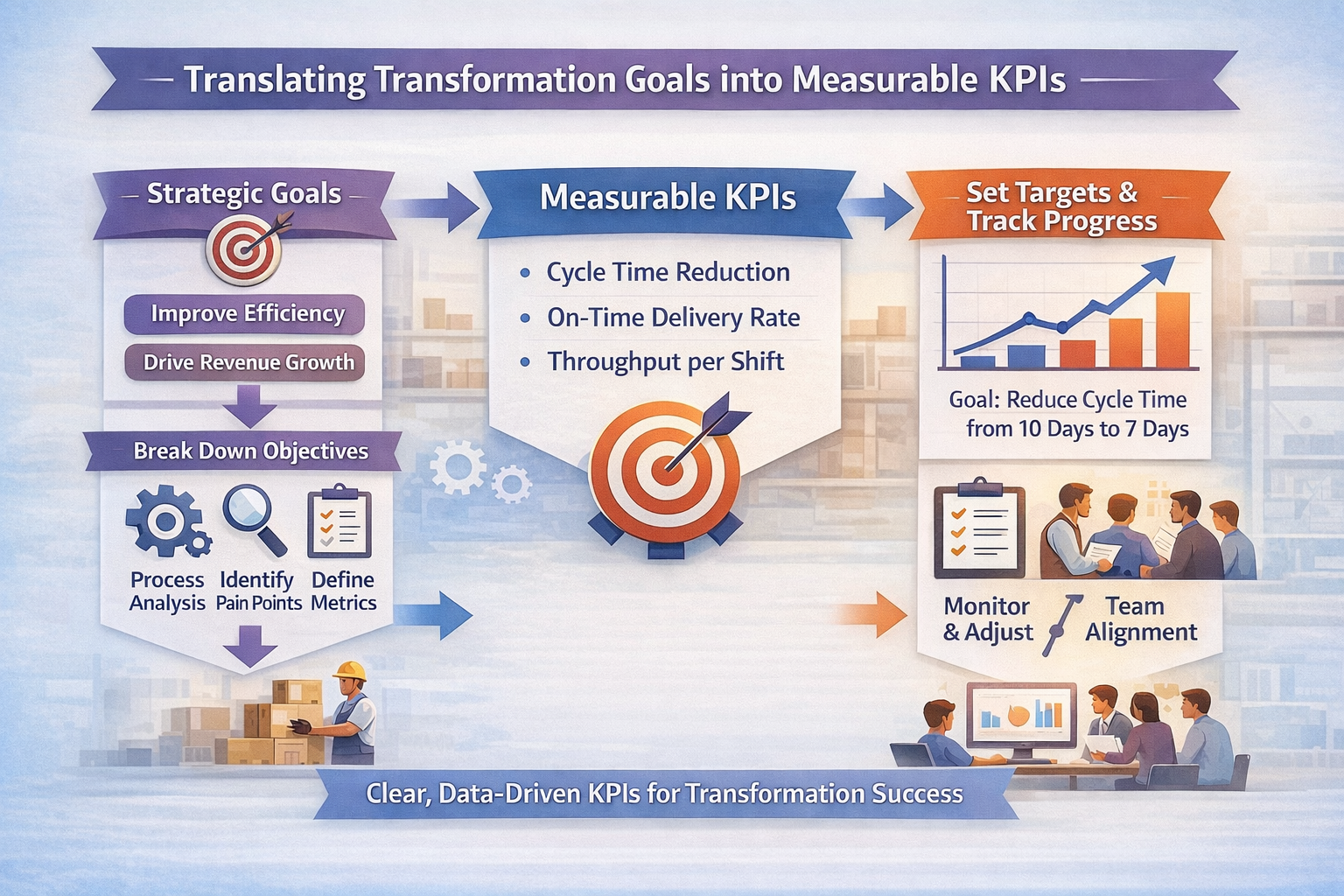
Strategic transformation begins with ambitious goals, but those ambitions only become reality when translated into specific, measurable KPIs. The process starts by breaking down high-level objectives, such as “improve operational efficiency” or “drive revenue growth”, into the core processes or outcomes that define efficiency for your business.
This translation requires a deep understanding of both the desired business outcomes and the operational levers that influence them. For example, if your operations team wants to reduce order fulfillment time. Begin by mapping the current process from order receipt to delivery. Identify the steps that cause the most delays or errors. Next, select KPIs that directly measure these pain points, such as average cycle time per order, percentage of orders delivered on time, or throughput rate per shift. Set clear targets for each metric, such as reducing average cycle time from 10 days to 7 days within three months.
This approach not only clarifies expectations for teams but also enables data-driven course corrections as conditions change. When KPIs are tightly linked to transformation goals, they become powerful tools for driving accountability, aligning resources, and sustaining momentum across business units.
Gaining genuine buy-in for transformation KPIs is essential for turning measurement into action. Stakeholders at every level must see KPIs as relevant, fair, and integral to their daily work, and not as vague metrics imposed by their heads or managers. Achieving this level of engagement requires clear communication, collaborative design, and ongoing reinforcement.
When introducing new KPIs, it’s important to connect each metric to the broader transformation narrative. You should explain not only what is being measured, but why it matters for the organization’s future. By framing KPIs as enablers of strategic goals and business benefits, teams are more likely to embrace them as tools for success rather than compliance. Regular updates, transparent dashboards, and real-world examples help reinforce the message and keep the focus on outcomes.
KPIs gain traction when they are woven into the fabric of daily management routines. This means integrating KPI review into leadership meetings, project stand-ups, and performance discussions. When decisions like resource allocation or project prioritization are explicitly linked to KPI performance, stakeholders see the tangible impact of measurement on their work. Over time, this integration builds a culture where data-driven decisions become the norm.
True buy-in emerges when stakeholders feel ownership over both the metrics and the results. Assigning clear responsibility for each KPI, providing the necessary tools and training, and recognizing achievements all contribute to a sense of shared accountability. When teams are empowered to influence outcomes and are rewarded for progress, KPIs become a source of motivation and pride rather than a reporting burden.
A static KPI system can quickly lose relevance as transformation progresses. As your business grows and priorities shift, your KPI system must keep pace. A static set of metrics will quickly become outdated and lose its impact.
Read Next: ERP Data Migration Checklist: Best Practices for Success
As organizations push for faster change and greater impact, measurement systems must evolve. Advanced approaches go beyond basic metrics, capturing the behaviors, cross-functional dynamics, and early warning signs that reveal whether transformation is truly taking hold. Adopting these methods helps gain sharper visibility, respond faster to risks, and build a culture that values both results and the way those results are achieved.
While traditional KPIs focus on measurable outcomes, transformation often hinges on shifts in behavior and culture. Key Behavioral Indicators (KBIs) provide a window into these human factors, tracking engagement, openness to change, and participation in innovation initiatives. By monitoring KBIs alongside standard KPIs, organizations can spot early signs of resistance or momentum, enabling timely interventions.
For example, a spike in training participation or peer recognition may signal growing buy-in, while declining engagement scores could indicate emerging risks. Integrating KBIs into the transformation scorecard ensures that both the “what” and the “how” of change are measured, supporting a more holistic approach to sustainable growth.
Transformation rarely follows a straight line, and early signals often emerge at the intersections of teams and processes. Cross-functional KPIs and leading indicators help leaders detect these signals before they become visible in lagging metrics like revenue or market share.
KPIs become truly powerful when they are linked to incentives and recognition systems. By tying rewards, such as bonuses, promotions, or public acknowledgment, to KPI achievement and positive behaviors, organizations reinforce the importance of measurement and drive sustained engagement.
This alignment encourages teams to focus on what matters most, fosters healthy competition, and builds a culture where continuous improvement is celebrated. Over time, a KPI-driven culture becomes self-reinforcing, with employees at all levels seeking out new ways to drive transformation and deliver measurable results.
Linking business transformation to strategic KPIs turns vision into value. By designing a balanced, actionable scorecard, aligning metrics with strategic goals, and embedding measurement into daily routines, organizations create the conditions for sustainable growth and competitive advantage. The journey requires vigilance, adaptability, and a willingness to evolve both metrics and mindsets as transformation unfolds.
Sustained transformation depends on a disciplined approach to measurement, a willingness to adapt, and the right expertise to turn data into action. RubinBrown helps you build a KPI system that adapts as your business evolves, supports executive decision-making, and delivers transparency at every stage. Unlock measurable value by leveraging our ERP Advisory Service to design a KPI framework that supports your strategy and delivers results you can track.
Operational KPIs, such as process cycle time or adoption rates, can show improvement within weeks of implementation. Financial KPIs, like ROI or revenue growth, often require several quarters to reflect the full impact of transformation. Set realistic timelines for each metric and monitor both early signals and long-term outcomes.
The core KPI categories—such as operational efficiency, financial impact, and customer outcomes—remain consistent across the organization. However, specific metrics may vary by location or function. For example, a plant may focus on throughput and downtime, while headquarters tracks revenue growth and margin. Align local KPIs with enterprise goals to maintain strategic focus.
Protecting KPI dashboards requires a combination of technology and process. Use role-based access controls, encrypt data in transit, and audit login activity regularly. Choose dashboard tools with multi-factor authentication and granular permissions. Assign data owners to ensure accuracy and consistency across all metrics.
Limit each transformation initiative to the right KPIs that directly measure progress toward strategic goals. Avoid the temptation to track every possible metric, which can overwhelm teams and dilute focus. Review your KPI set regularly and retire those that no longer drive decisions or add value.
Establish a routine data-quality audit to flag issues like mismatched units, missing values, or outdated sources. Assign clear ownership for each KPI and document data definitions. Use automated tools to validate data and provide alerts when anomalies occur. High-quality data is essential for trustworthy measurement and decision-making.
Pair every new KPI with a clear communication plan that explains its relevance and impact. Involve stakeholders early in the design process, provide training on how to use and interpret metrics, and integrate KPIs into regular management routines. Recognize teams that achieve KPI targets and use feedback to refine your measurement approach.

6 min read
…and does it really apply to me? Organizations often find themselves in the position of replacing or upgrading their Enterprise Resource...
.png)
4 min read
 Paul Dustin : Mar 4, 2024 12:59:19 PM
ERP (Enterprise Resource Planning) discussions include Business Transformation at an increasing rate. Transformation may sound impressive – or...

In today's fast-paced and highly competitive business landscape, companies need to adapt and transform to stay ahead, but implementing new processes...